Human Skills
Foundations
What We’ve Covered
Virtual Session: Motivation
-
🃏 Unofficial Start

“What is something like a one word that represents a skill that you’re working on right now?” — music already playing, question already on the screen, no on-ramp.
What came back in the chat: productivity, time management, organization, self-awareness, release, anxiety, patience, unreactive, adjustments. One of you named the anchor from an earlier session as the thing you’re actively working on — “don’t be a judge… being a detective. That’s what I’m really having a hard time with. My snap judgment.”
Someone hyphenated two words to beat the one-word limit. That got named as the point, not the problem — rules versus constraints. “That amount of cheating — actually, let’s refer to that as creative thinking.”
Behind the curtain An enrolling question before the official start primes the room and gets people contributing, instead of burning the first few minutes waiting for everyone to arrive. The one-word limit does the other half of the work — being concise is harder than being complete. -
🔮 2027, All At Once
Nearly every hand went up for “how many of you are already starting to think about 2027?”
“Type in your chat box what you are thinking about for 2027, but don’t hit enter yet. We’re all going to hit enter at the same time.”
Countdown, then: Graduations. Portfolios. Days off. Caseloads. New programs, new challenges.
The three-year cycle surfaced right away — programs you worked with three years ago are coming back around, and they may have new directors, new staff, new everything. Show of hands: one director can change the culture of an entire program.
Pro Tip The don’t-hit-enter countdown is why the chat blast works. Everybody answers at once, so nobody gets anchored on the first response. -
⚖️ The Worry List and the Opportunities List

“We usually have a list of things we’re worried about, whether that’s conscious or not conscious. It’s usually there. And then a list of opportunities that may come up. Now the opportunities list, you probably guessed, is usually a little bit harder. That one sometimes takes a little bit of work — because the worry list can be so loud.”
In your breakouts, seven minutes: talk about your worry list, your opportunities list, and tie it to a real experience — a director, an educator, the grading system that decides whether you have a budget next year.
The debrief poll: whose was all worry? Nearly every hand. Eighty-twenty? The rest. Mostly opportunity? Nobody.
Your own explanation of it: “Part of our job description says self-starter, self-motivated — which to a woman translates as riddled with anxiety to get all the things done all the time.”
Then the callback: we feel, then we think, then we think, then we feel. There’s no avoiding the loop. Getting from the worry list to the opportunities list takes deliberate extra work — it’s the detective hat, pointed at your own planning.
-
📋 What You Asked For

A hand-drawn readback of your own survey results, pressure-tested live — “see if it still feels true in this moment, because that was a couple weeks ago, and now it’s August.”
Top 3 — wish there was more…
- Difficult conversations.
- Handouts. Physical things you can hold and use.
- Using AI. In a way that stays human.
Top 3 — human skills needed…
- EI and emotion regulation.
- Decision confidence. “Having a decision that goes out and feeling like, regardless of the outcome, it was the right call.”
- Influence and behavior change. “Not like influencer influence.”
Top 3 — focus areas…
- Difficult conversations. Second appearance. “Two dots. I see a line. That seems like a pattern.”
- Facilitation and engagement. Especially online.
- Practice and integration. You know these things — you need room to work them.
On that second one The whole framework behind how these sessions get built is already free on YouTube, with a companion guide. Steal it, hack it, adapt it — it's built to be taken.Watch on YouTube -
🔺 The Alignment Model

“The things that we do in the next X period of time don’t matter unless they’re tied to what we care about in our goals.”
“So I built this model to share with you today, and I want to fill it out kind of as best I can, and then I want to give it to you so that you can bend it, break it, fill it in, and beat this thing up a little bit.”

Four layers, top to bottom:
- Outcomes. Funding and impact. Every decision and every skill developed has to align with these. With the honest caveat: “sometimes the systems of grading and metrics that we use to figure out budget and funding are not actually tied to the things that matter.” And more than one body decides them — DECAL and Albany State both.
- Performance measures. “The outcome is maybe that you get the funding or that we’re making the impact. But what are the metrics we’re using to measure those things?” Some internal, some handed down.
- Skills, habits and behaviors. “In order to get those results, what are the behaviors, the skills, maybe the capabilities?” Including a pushback on the sector’s default term: “in early childhood the language I hear for this is capacity building… I don’t really love that. We should be thinking about the skills.”
- Management systems. ETO, TORSH, SOPs, reporting, admin for both masters — and incentives. “Sometimes we operate within a machine that is not set up for our success.” Some of that red tape is unchallengeable. Some of it was written, which means it can be unwritten.
The punchline Training and PD happen at the bottom of the model. The impact lands in the behaviors layer. “So to me, this is kind of the alignment path of: is everything we do aligned with the outcome we want to see as a team?” -
🔨 Break the Model
Two rounds of ten minutes, a scribe per group.
“Think about filling this out as best you can and challenging some of the orientation of it. Is there another layer in here that’s missing? Is this actually a pyramid, but it’s actually upside down? Like the pyramid’s wrong, it goes the other way.”
When a group asked whether to fill it in or rebuild it: “Do whatever is generative right now.” Fill the gaps if that’s where the energy is. Remodel it if that’s where the energy is.
Between rounds, the honest read: “We could have used about another hour on that.” After round two: “Yes, but it still wasn’t easy.” Nobody raised a hand for we did it, we’re done.
Behind the curtain The yo-yo. When you’re first learning to walk the dog, you hit yourself in the head and swing it around and it isn’t fun — and then twenty or thirty minutes in, you’ve got it. New models and new ways of thinking work the same way. The traction is the reward, and it only shows up on the far side of the awkward part. -
🧊 What You Built
Three models. None of them a pyramid.
🧊 The Iceberg
“So much of it is under the surface. It’s the background, it’s the people at the office, it’s all the requirements through DECAL and ASU.” Then licensing minimums — “we can’t go on to our TA until we know they’re meeting minimums” — then training, coaching, TA at different levels, and the ERS, ETO and TORSH work stacked on top.
A second version walked it top-down: outcomes and impact at the peak (what you celebrate — provider success, quality-rated stars, improved scores, child outcomes, workforce stability), then performance measures, then behaviors and capabilities, then systems. And at the very bottom, why we choose to do the work we do.
A dissent worth keeping: “I really like the iceberg, but I have no business side when it comes to this. It was teaching, now I’m a TAC, and I’m working with kids… we really don’t deal with a lot of stuff that’s in the water. It’s more above the water.”
🌳 The Tree
“There’s stuff under the ground that’s not seen. And then there’s fruit that sometimes comes and sometimes doesn’t come. And then there’s leaves that change with the seasons. But the trunk is the core of what we do.”
By the last round it had grown into a whole ecosystem: outside factors you can’t change (“we’re not the rain” — and “who our new governor will be in November”), bees as the workers, and providers as reciprocal feeders — they benefit from a healthy tree and they feed it back.
The strongest argument in the room “If the providers can’t sustain their business, and they can’t feed their own family, and if they keep closing their businesses, then there’s no childcare for nurses and doctors and lawyers and scientists, and then the whole system just combusts on itself. And that leaves us with no job.”🎂 The Birthday Cake
This group tore up the pyramid because two people in it were reading the same shape two different ways — “so we wanted to develop a shape that maybe took that mix out.”
“We quickly determined that in the real world, all the layers would be like the same size, because nothing’s really more important than anything else.” DECAL and ASU, admin systems, technical assistance (“we felt that deserved its very own layer”), knowledge and skills and abilities, performance measures, funding — with the candle as the impact.
The structural insight of the day “We realized through our discussion that each layer of icing was the behaviors — because it’s embedded in every layer of this work. That’s where we see those human skills and those human behaviors.”What all three had in common: “One of the things that’s really great about all of your models is that there is an alignment component. It’s either vertical, or it’s pointing in all directions to one thing.”
-
⚡ Useful, Not Just True
“One question that I would like to ask you is: not only is it true, but is it useful?”
“There’s a very normal human habit where we say to ourselves, well, I need to speak out, I need to share my opinion. And that’s great — I’m not trying to put that down. My follow-up is: is it getting the results that you want? Sometimes I say the thing that’s true to me and then it doesn’t land. It doesn’t work. It doesn’t get the outcome I want.”
“We only have so much time. We only have so much money. We only have so much attention. We only have so much energy… It’s just not enough to be true. It’s 2026. It’s not enough to be true. It has to also be useful.”
Then straight back into breakouts — fifteen minutes this time, not ten — to run the models through that lens.
-
🎛️ What’s Actually In Your Control
“In the chat, put one emoji that represents your mental energy right now.”
What came back: goofy faces, zombies, squiggly eyes, mind-blown. Somebody wanted a drool face, couldn’t find it, went with a zombie.
Named out loud rather than smoothed over: “this is actually a really normal part of the process, which is an uncomfortable and not fun thing for me to say — it usually gets a little bit messy before it gets clearer.”
Then the narrowing move — the red dashed box that went around the board above: “What are the few things in our model that are actually in our control? They have to align with a lot of the stuff that’s maybe not in our control. But when we focus on just a few things, it helps us really narrow in and focus our energy.”
Worth sitting with We’re not in harvest mode. We’re in plant mode. -
🤫 Three Minutes, Cameras Off
Cameras off, timer on screen, quiet music, private writing.
“In your private quiet space, what I want you to jot down are questions, thoughts, comments that you feel I might be able to speak to, answer, point you in the right direction. Maybe you have a question about research — like, what literature do we have on this behavior? Maybe you want to know what software I use to put this timer up. Whatever you want. Ask me anything.”
Pro Tip Questions don’t arrive on demand in a full room. Give people privacy and a clock, and the question they were half-forming gets a chance to finish. -
💬 Ask Me Anything
On the research process
Three years running a pediatric neuroscience lab at Penn State, working with people who asked better questions — that’s where the study-design literacy comes from. “If you understand statistics, you know if that’s good or bad, or you can look at the methods section of how they did it.” Plus knowing which journals are reputable and which ones let anybody publish.
The filter is meta-analyses over cutting edge. “Just because they figured it out over here doesn’t mean they can replicate it in Australia, or in Lisbon… My gut check is more around meta-analyses, which just means: here’s the body of work in this field. What do 99% of scientists agree on? That’s what I want to base my work and thinking in.”
On using AI without losing the human part
The diagnosis first: “most people, when they use AI, are using it like Google.” And the warning — it’s trained on language, so “when it tells you something, it sounds really convincing. It sounds like it’s true. And a lot of the time it might not be.”
Two practices that actually change the output:
- Assign the roles. “It is the computer and I am the human. My job is to give you discernment and judgment and taste, and your job is to generate and to be clear.”
- Speak, don’t write. Dictating gives it far more context — your goal, your constraints, the way you want it done — than you’d ever type. “So talk to it. Don’t type to it.”
Why that works The rubber duck. Software developers found that talking a problem out loud — even to a rubber duck on the desk — dislodges solutions that staring at the screen won’t.On silence
“That’s one thing you have to get used to no matter what you’re doing in terms of virtual engagement.” Not comfort with it — survival of it. “I have to kind of count and be like, all right, don’t jump in.”
Standing offer Any question that didn’t get asked out loud still gets answered. “I will answer. Every question. As best I can.” -
✨ Closing
“I’m happy to hang out and stay, but I know a lot of you really need some blood sugar adjustment. So please go and eat lunch. You are allowed. You are allowed to leave. We’re way past time. And I know educators don’t want to break the rules. So get out of here.”
Behind the curtain That isn’t a throwaway. There’s a well-known study of judges handing down harsher decisions right before the lunch break than on similar cases earlier in the day — blood sugar, biology, not character. If you skip lunch to be more useful to people, you’re doing the opposite. (The size of that effect has since been challenged — both papers are in the Sources below.)One ask Send your model — the tree, the iceberg, the cake — to Chris, or to Cindy to forward. “I would love to see all the models. That will help me understand more about what’s at stake, what systems you have around you, and what things we can do to help support you.”
Resources and Links
How to Make Virtual Engagement Easy
Yay! Congrats on getting this free book on Virtual Engagement.
Inside Out 2
Brought up as the best available argument that anxiety is a signal, not a defect. Watch it and try to tell us we’re wrong.
Sources📌 The research behind today
- The judges and the sandwich — Danziger, Levav & Avnaim-Pesso (2011), PNAS. Worth reading alongside Glöckner (2016), which argues the effect is smaller than the original reported. Both are true; the sandwich is still a good idea.
- “I would have written a shorter letter, but I didn’t have the time” — not Twain. Blaise Pascal, Lettres Provinciales (1657), Letter 16.
- Rubber duck debugging — Andrew Hunt & David Thomas, The Pragmatic Programmer.
- Where the research comes from — PubMed and Open Evidence.
Virtual Session: Motivation
-
🃏 Unofficial Start

A word for willpower “What’s a word you think of when you hear the word willpower?” — dropped in the chat. Positive or negative, no judgment.
Facilitation Tip An enrolling question before the official start primes the room and gets people contributing, instead of burning the first few minutes waiting for everyone to arrive. -
🤝 Connection Before Content

Find your object 
The breakout question Find an object in your space that represents one way you’re using willpower right now to make yourself do something.
In your breakouts: share your object, then — what’s one way you’re using willpower to compensate for low motivation right now?
-
🥂 Group Challenge — The Toast

Cheers — the toast Everyone grabbed their object — a shoe, a lint roller, a paper clip, a mug — held it overhead, and kept it up while Chris delivered a long, deliberately drawn-out toast.
Behind the curtain The toast wasn’t the point. Holding that object up got harder the longer you did it (that’s effort over time), your attention kept sliding to your aching shoulder (that’s attention), and you kept holding it because everyone else was (that’s social pressure). The whole willpower model, in your hand: it’s effort plus attention, and it bends to the people around you. -
🌉 The Willpower Bridge

The bridge, not a gas tank The old story: willpower is a tank of gas. You start full, spend it down, and burn out. That’s why “you just need more willpower” feels true and useless at the same time.
Better picture: a bridge. You’re standing in the motivation you have right now; the action you need is on the other side. To cross, you go UP — that’s effort, the force you’d use to push yourself — and ACROSS — that’s attention, where your focus is actually pointed. Like a vector in high-school physics: it needs both a size and a direction.
Picture itProcrasti-cleaning
You sit down to do the hard thing and suddenly every doorknob in the house needs polishing. You have the energy — your attention just landed on the wrong thing. There’s a word for it: procrasti-cleaning. Often what’s missing isn’t willpower. It’s attention.
Anchor Think of it as a bridge, not a tank of gas you’re going to run out of. -
🩺 The Motivation Vital Signs

The five vital signs Five things to check when motivation runs low — a quick guidebook to take your temperature. Built on Self-Determination Theory; the first three are the ones Dan Pink popularized in Drive.
- Autonomy. Did I choose this? Do I have any ownership over the task or the outcome?
- Competence. Can I actually do this — and is there a path to getting better? (Pink calls it mastery. Sometimes you do it first and feel the competence after.)
- Purpose. Does this matter beyond this moment? If you can’t see the bigger picture, you won’t keep going for long.
- Relatedness. Do I belong with these people doing this work? Are these my people?
- Compassion. Empathy alone absorbs other people’s pain and burns you out — that’s empathic distress. Compassion is different: “I see your suffering, I can’t stand to see it, so I must help.” It turns feeling into action — and the action is what’s motivating.
-
🎚️ The Four Levers

The four levers Four things actually in your control. They run on a gradient: the top levers are fast and easy but wear out; the bottom ones take time but last.
- Willpower. Forcing it. Not bad — just the easiest lever, so we overuse it. Like a muscle, it gets harder to use the more you lean on it.
- Make It Smaller. Every big, hairy, scary thing is made of small, totally doable steps. Zoom in: what’s just the next step? (It’s why “Just Do It” works — “just” shrinks the task. It’s why seeing the finish line made the maze feel possible.)
- Diagnose the Vitals. Run the five vital signs. It won’t fix the moment, but it solves the problem long-term.
- Build Capacity. The lever we skip — and to be clear, this isn’t “do more.” You’re already hardworking and resilient. It’s recovery: effort without rest is going to the gym, picking things up and putting them down, never sleeping, never eating right — you’re going to hurt yourself.
Anchor — Recovery isn’t optional Constant stress without recovery builds allostatic load — your neurons literally get worse at managing stress. It’s a negative feedback loop: skip the rest, and future rest gets harder to come by. You’re already hardworking, resourceful, resilient people. Nobody needs to tell you to work harder. -
🔍 Debrief — How Would the Detective Handle This?

Which lever is underused? 
How would the Detective handle it? Camera off, three minutes: which lever is most underused for you, and how? Then in your breakouts: how might the Detective — not the judge — handle it? (The running move from last session: don’t be the judge, be a detective. Turn that same stance on yourself.) The room kept landing on the same underused lever: Recovery.
StoryMama Bear
Running nationally touring Lego and Minecraft kid shows — 20–25 a year, four to five days each, constant travel — people got sick and would never tag themselves out. So the team made a rule: mama bear that person. Take them off the walkies, off the laptop, no phone — and make them actually rest. (Caveat: a few years of doing it, no formal data — but it worked.)
Pro TipDefend the rest
One move from the room: take a sick day for a mental-health reset and save your vacation days for actual vacation. Protecting recovery is part of the job, not a reward for finishing it.
-
🎯 Action Storm

Action Storm Back in your breakouts: turn your ideas into small experiments. Land on one move — “When ___ happens, I will ___.” Framing it as an experiment (not a vow) makes it less daunting and easier to actually start.
Accountabilibuddy: pair up and finish — “When I leave I will ___. You can help me by ___.”
-
✨ Closing

I am / I believe / I will Everything from today — the bridge, the five vital signs, the four levers — lives right here at chrisdanilo.com/butterknife25.
On your way out, finish one of these in the chat:
- “I am ___”
- “I believe ___”
- “I will ___”
Behind the curtain When we name it, we’re more likely to do it or believe it. (And — take a break, will you?)
Resources and Links 📚 Books mentioned today
Drive
The business-friendly translation of self-determination theory — where autonomy, mastery (competence), and purpose come from. Pink takes the science and makes it usable.
Sources📌 The research behind today
- Self-Determination Theory (autonomy, competence, relatedness) — Deci & Ryan; translated for business in Dan Pink’s Drive
- Measuring work motivation — Multidimensional Work Motivation Scale (Gagné et al., 2015)
- Empathy vs. compassion / empathic distress — Singer & Klimecki (2014), Current Biology
- Allostatic load (stress without recovery) — McEwen (1998), New England Journal of Medicine
- Willpower science & the depletion reframe — Kelly McGonigal, The Willpower Instinct
Virtual Session:
Behavior Change
(🕵️♀️ Be The Detective)
-
🃏 Unofficial Start

Welcome back “What’s one thing that went really well in May?” — dropped in the chat.
Facilitation Tip Starting with a low-risk question like this improves engagement and sets the tone for a safe place for contribution. -
🤝 Connection Before Content

The sentence stem Finish this sentence stem: “I keep trying to change ___ , but ___ keeps getting in the way.”
In your breakouts: share it, and look for the common pattern across the group. Most of what came up was about changing our own behavior — and the room kept taking full ownership of it, which is both admirable and workable.
Pro TipStack your intentions
“I’ll go to the gym tomorrow” is weak. “At 7am” is better. “At 7am, doing this routine” is better still. “At 7am, this routine, and I asked a friend to meet me there” is strongest. Each layer raises the odds you actually follow through.
-
🚣 Group Challenge — River Crossing

River Crossing — the setup 
The constraints Get the farmer, the chicken, the fox, and the bag of corn from the south bank to the north bank.
The boat carries the farmer plus one item. Never leave the fox alone with the chicken, or the chicken alone with the corn. Fewest moves wins.
🏆 Winning Stakes: A FREE Book! — first group back with a working solution wins their pick from Chris’s reading list.
Winners: email Chris with an address and which book you want!
Behind the curtain The point wasn’t the puzzle. Nobody tried to reason with the fox or lock it in a cage — you can’t change a fox’s DNA. You changed the order of operations and the conditions instead. That’s exactly the move with the people you’re trying to influence. -
🐔 Why Change Is Hard — The Outposts

Why did the chicken cross the road? Why did the chicken cross the road? Ask a neuroendocrinologist, an evolutionary biologist, and a physiologist and you’ll get three different answers — and each one is true. That’s Robert Sapolsky’s frame, from Why Zebras Don’t Get Ulcers.
Behavior is too big to fully explain: genes, hormones, history, mood, a worldview formed in childhood, a habit reinforced for decades. The trap is that when your only tool is a hammer, every problem looks like a nail.
So let most of it go. A fox will have the DNA of a fox. Zoom out to see the whole picture, accept how little of it you control, then zoom back in on the few places you actually have influence — the question you ask, the relationship you build.
Anchor We feel first, then we think. Presenting the logic — “if everyone could just see the data” — almost never changes behavior.Picture itLisa Simpson, door to door
Remember Lisa in The Simpsons Movie — going door to door about the lake, then giving her big presentation, “An Irritating Truth”? She had every fact right. The town tuned her out anyway. Being right isn’t the same as being heard. It’s the door-to-door scene in The Simpsons Movie.
-
🔄 The 4F Debrief

The 4F Debrief Three minutes, camera off, in your own head — a reusable way to process any experience:
- Facts. What happened?
- Feelings. What came up for you?
- Findings. What did you notice or learn?
- Future. What will you do with it?
(Roger Greenaway’s active-reviewing model.)
-
🔍 Be the Detective, Not the Judge

Part 1 — Build trust 
How to be the Detective Part 1 — Build trust and deep understanding.
Story🔍 “Be the detective, not the judge”
Chris built a tight, multi-stage hiring pipeline for his friend and mentor Scott Woods — full of disqualifiers and deal-breakers. Scott’s note: “This helps us grade and judge candidates, but it leaves no room to understand the context behind their decisions. Be the detective, not the judge.”
❌ Instead of this ✅ Try this Pushing everyone to agree the system is fair Align on one piece of common ground: “If you stay at one star, the program closes. We both want it open — let’s play the game together.” Listening to win — waiting to jump in and be right Listening to understand — chasing the root issue (motivation? belief? capacity? lip service?) Asking “Why didn’t you do it?” (puts them on defense) Asking “How did you come to that decision? Help me understand your thinking.” Anchor — Detective vs. Judge The Judge already decided the verdict and is looking for evidence. The Detective is looking for what’s actually true. Pick on purpose. -
🌱 Plant Seeds, Not Flags

Part 2 — Spark the change 
How to plant seeds Part 2 — Spark the change. Once you’ve earned a little trust, help them get to their idea. Don’t plant a flag on it.
❌ Instead of this ✅ Try this Selling your idea Ask permission to share: “The way you’re describing this reminds me of another program that hit the same wall. Can I tell you how they handled it?” Prescribing the solution Share an example / case study: “What about the way they did it might transfer to you?” Deciding for them Ask for their choice: “Your scores are here. What would you like to do? I’ve got a few ideas for where we could start — want to hear them?” This runs on cognitive dissonance: when someone says yes to hearing it, they’re more likely to listen and act, because they want to stay consistent with that yes. Same reason you don’t ask a six-year-old “do you want to brush your teeth?” — you ask “blue toothbrush or green?”
-
✅ Accountability Checks

Part 3 — Accountability checks Part 3 — Keep it moving. Accountability isn’t someone standing over your shoulder. It’s buy-in plus a way to see progress. These are sentence stems — starting points. Rebuild and reinterpret them in your own words for your people:
-
“How will we beat the necessary evils?”
Full example: “I get it — you don’t want to be part of this system. But if we don’t play the game, we lose. So what are the necessary evils we have to get done to make this work for you?” -
“What must be true for ___ to occur?”
Full example: “What would have to be true for that change to actually happen?” Their answers — even the off-base ones — give you something to measure. -
“How will you know ___ is working?”
Full example: “How will you know your hard effort is paying off?”
Because the ideas are theirs, they’re more likely to act on them — and every time one of your suggestions works, you bank a little more trust.
Anchor — Emotional jujitsu Don’t meet their weight head-on or it’s a fight. Lean back, take their weight, and guide it somewhere productive. The energy for this comes from compassionate detachment — zoom out, build a little compassion, stay patient. -
“How will we beat the necessary evils?”
-
🎯 Action Storm — Practice Being Detectives
Back in your breakouts: share the change you’re trying to make and what you’ve tried so far. Be detectives for each other — ask How questions, dig for the root issue, and plant a seed or two. Practice on people you trust before you need it in the room.
-
✨ Closing

On your way out On your way out, finish one of these in the chat:
- “I am ___”
- “I believe ___”
- “I will ___”
Behind the curtain When we name it, we’re more likely to do it or believe it.
Resources and Links 📚 From the reading list
🏆 Won the River Crossing challenge? Pick any title from Chris’s reading list. Winners: email Chris with an address and which book you want!
Sources📌 The research behind today
- Robert Sapolsky, Why Zebras Don’t Get Ulcers — author · book
- Implementation intentions — Gollwitzer (1999); accountability — Matthews (2007), Dominican University
- Cognitive dissonance — Festinger (Britannica)
- The 4F Debrief — Roger Greenaway, Active Reviewing
- Quality Rated — Georgia DECAL
- “An Irritating Truth” — The Simpsons Movie (2007)
Virtual Session:
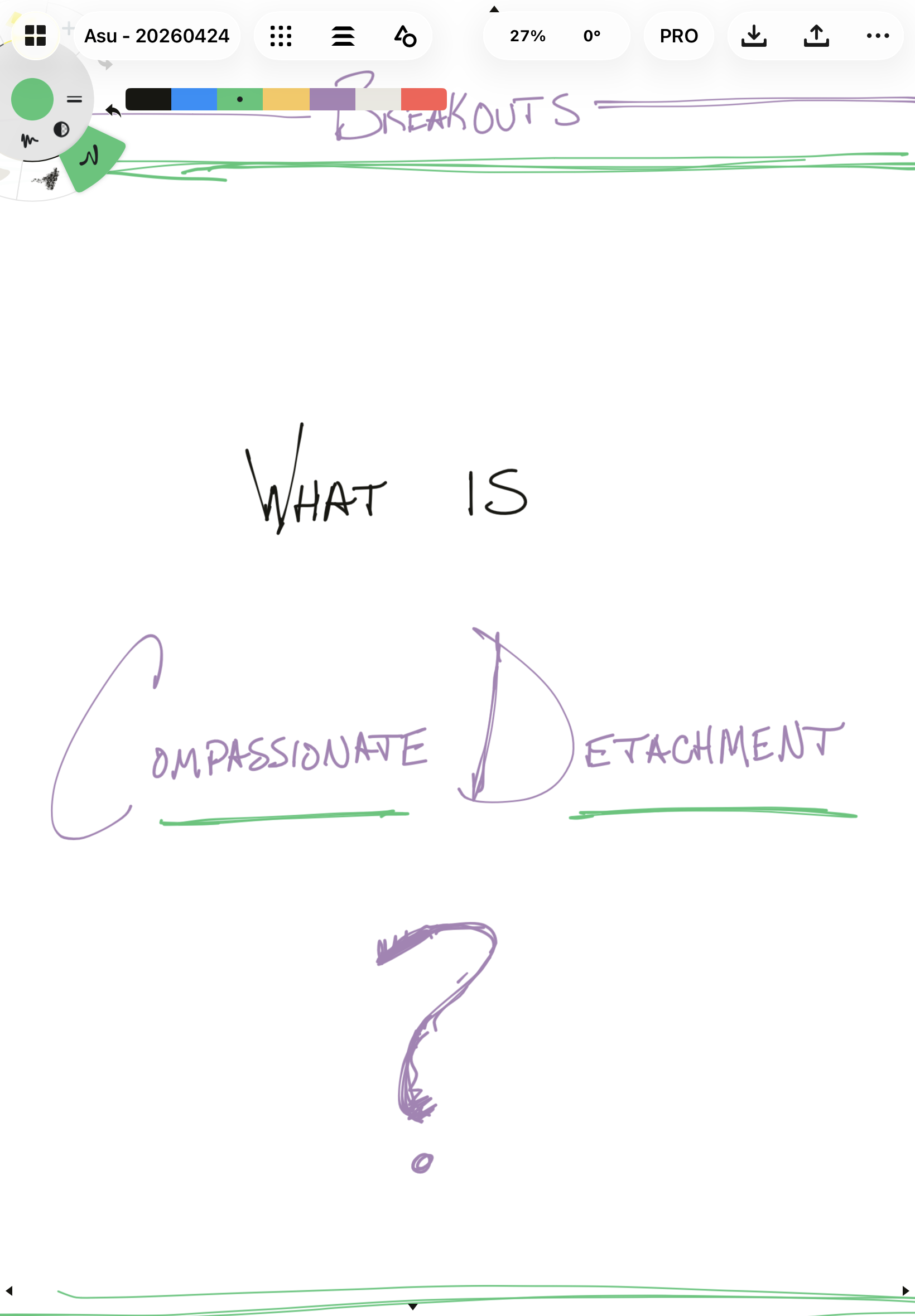
Compassionate Detachment
-
🃏 Unofficial Start
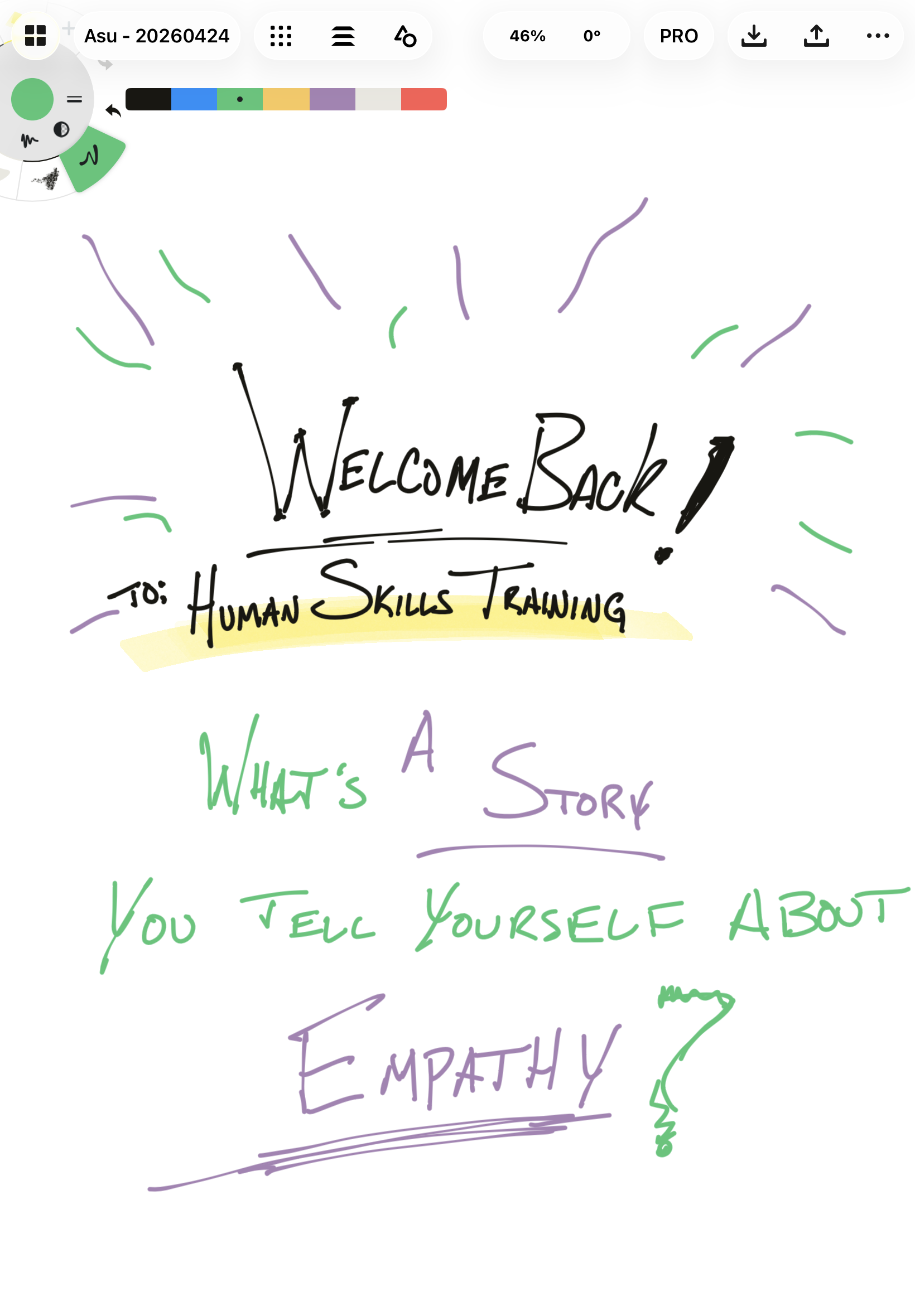
“What’s one thing you’re telling yourself about EMPATHY right now?”
Behind the curtain An intentional question in the unofficial start avoids the typical time wasted “waiting” for others to be present. It primes for the session and gets engagement started. -
🤝 Connection Before Content
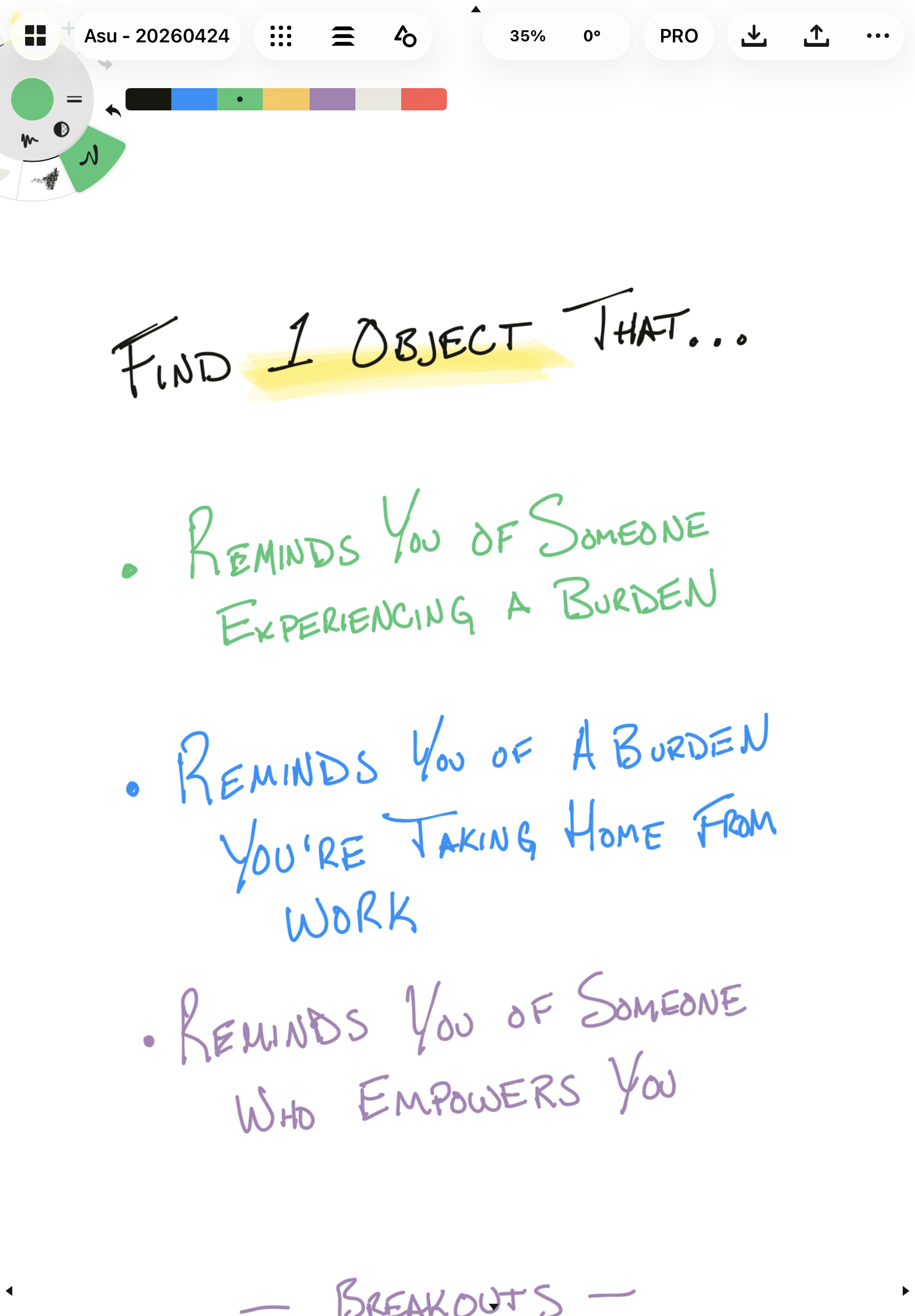
Pick one object that does one of these three things:
- Reminds you of someone carrying a burden.
- Reminds you of a burden you take home.
- Reminds you of someone who supported you.
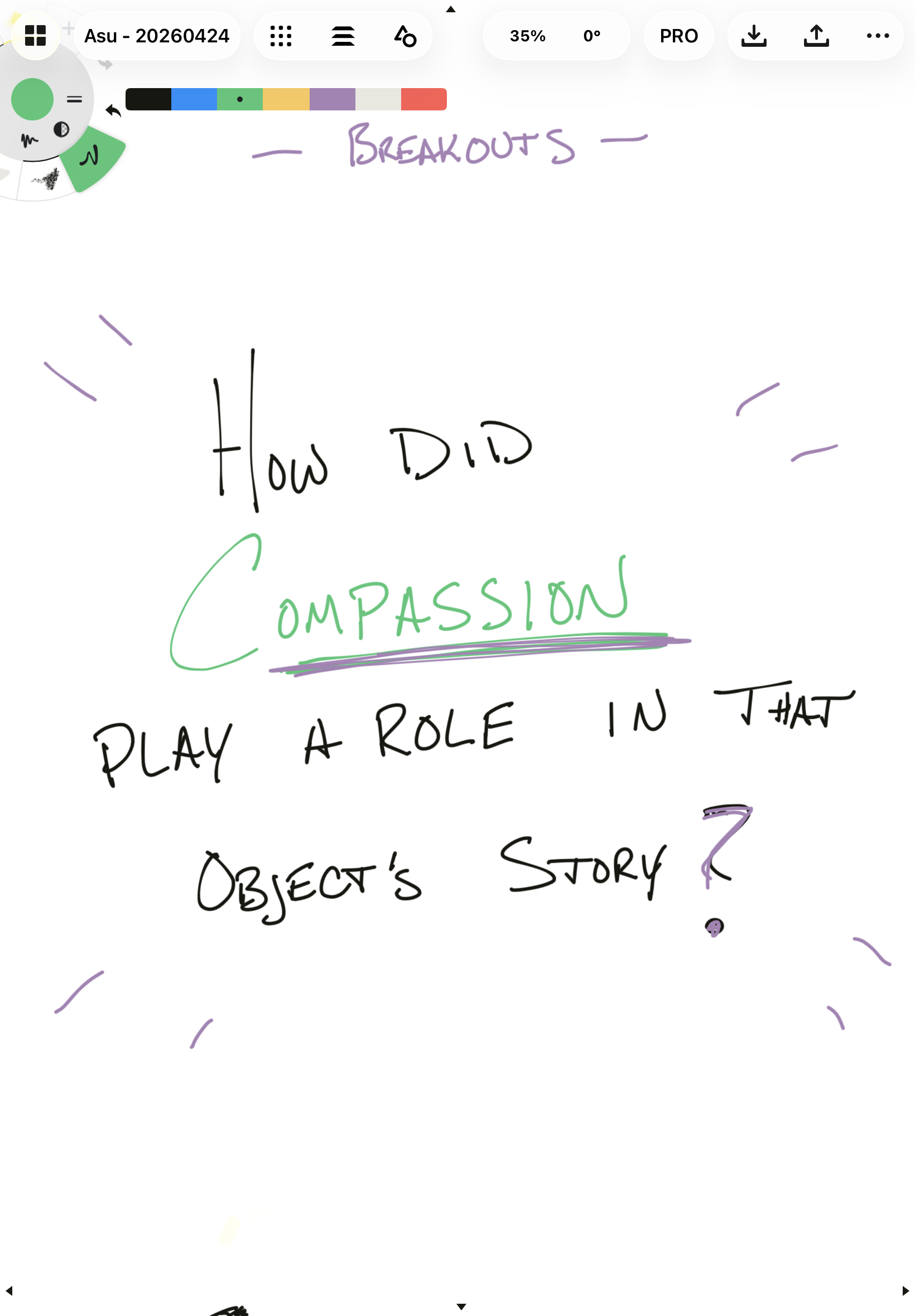
In your breakouts: how did compassion play a role in your object’s story?
-
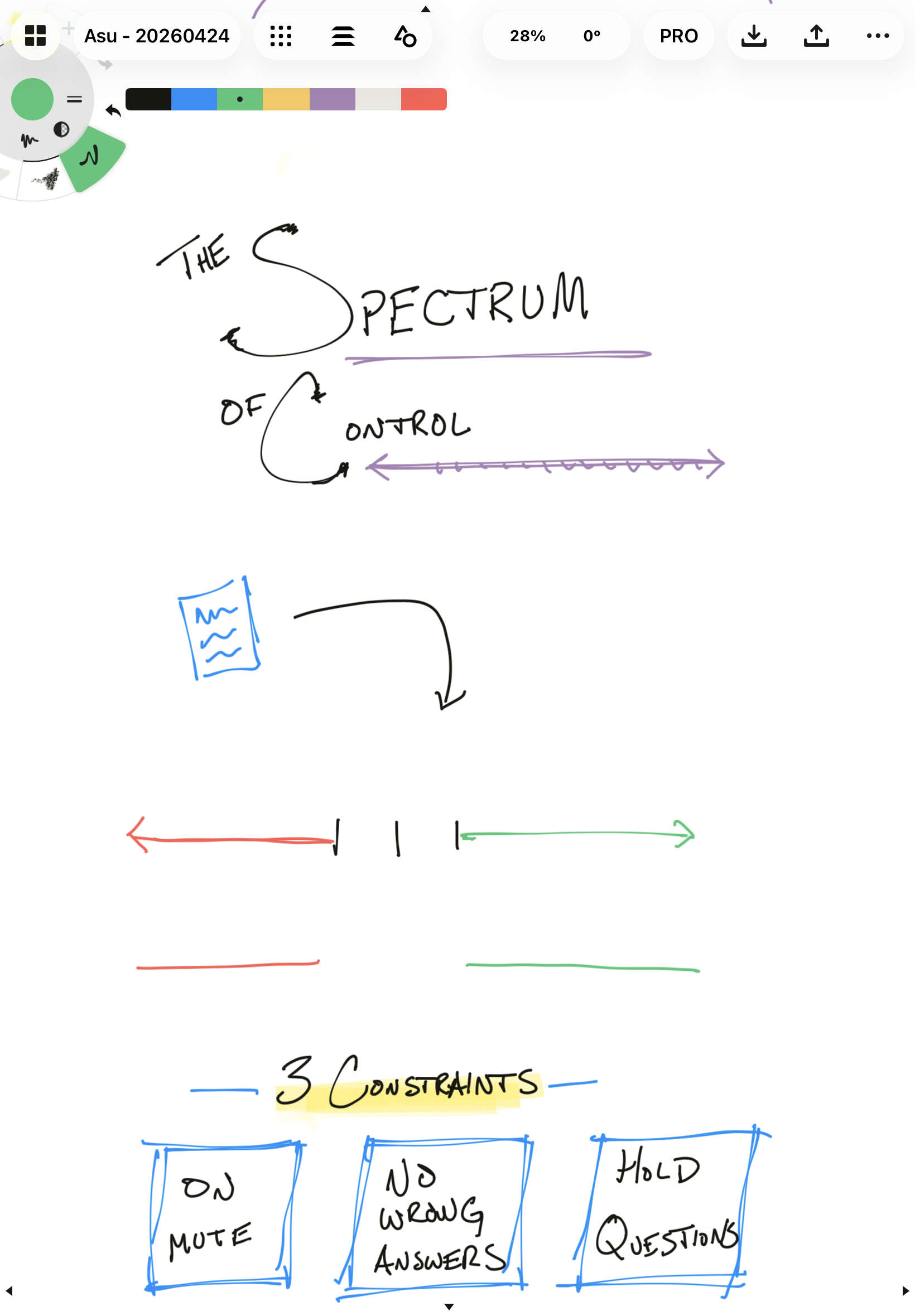
🧭 Spectrum of Control
Forty statements. You positioned yourself on each one.
The point wasn’t to get it right. It was to notice where your body went, what you wanted to argue with, and where you surprised yourself.
Then a quiet pass on three questions, alone:
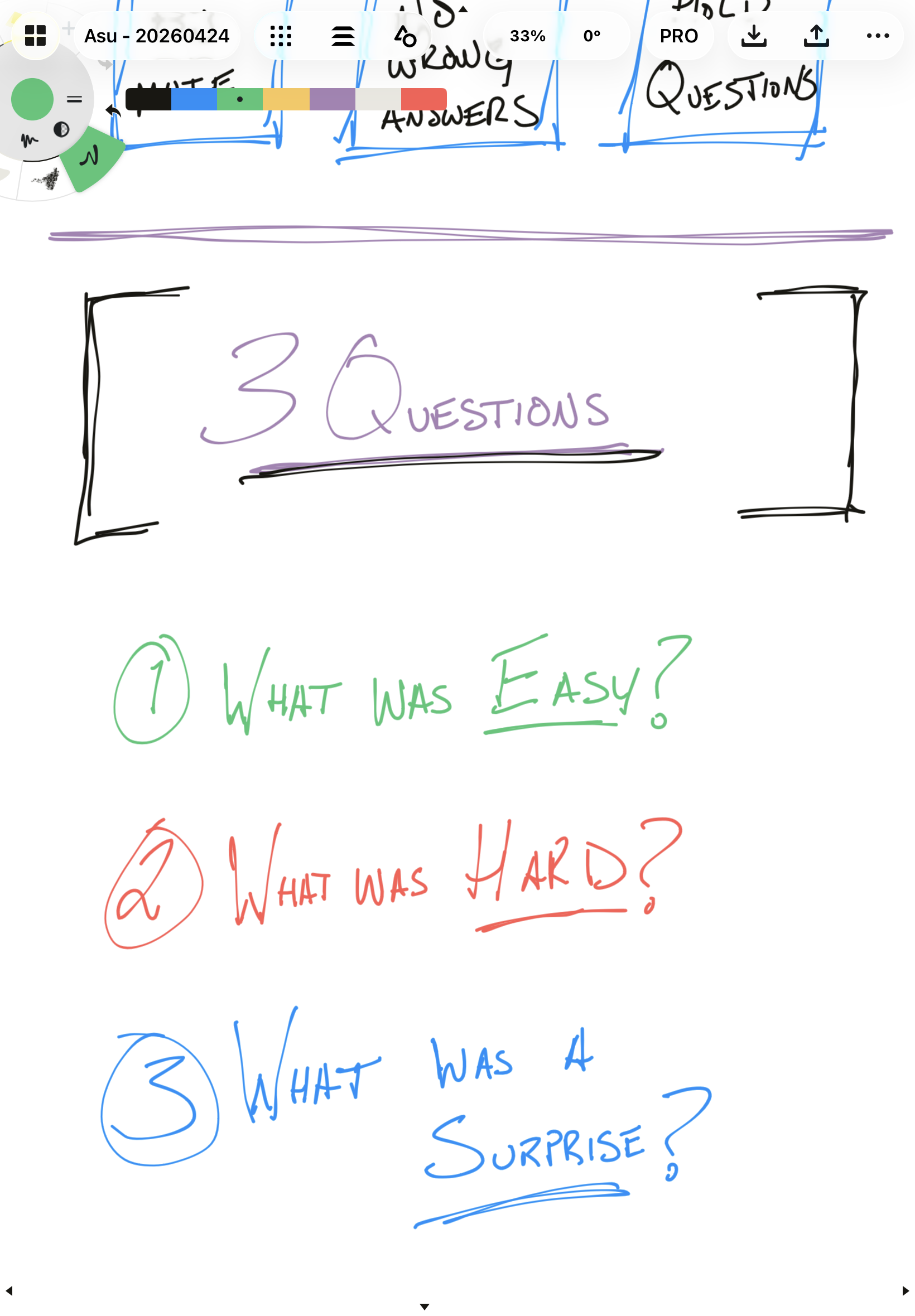
- What was easy to answer?
- What was hard to answer?
- What was a surprise?
Same three questions in your breakout group. Then a popcorn share back together.
-
🦺 The Three Responses + The Grid
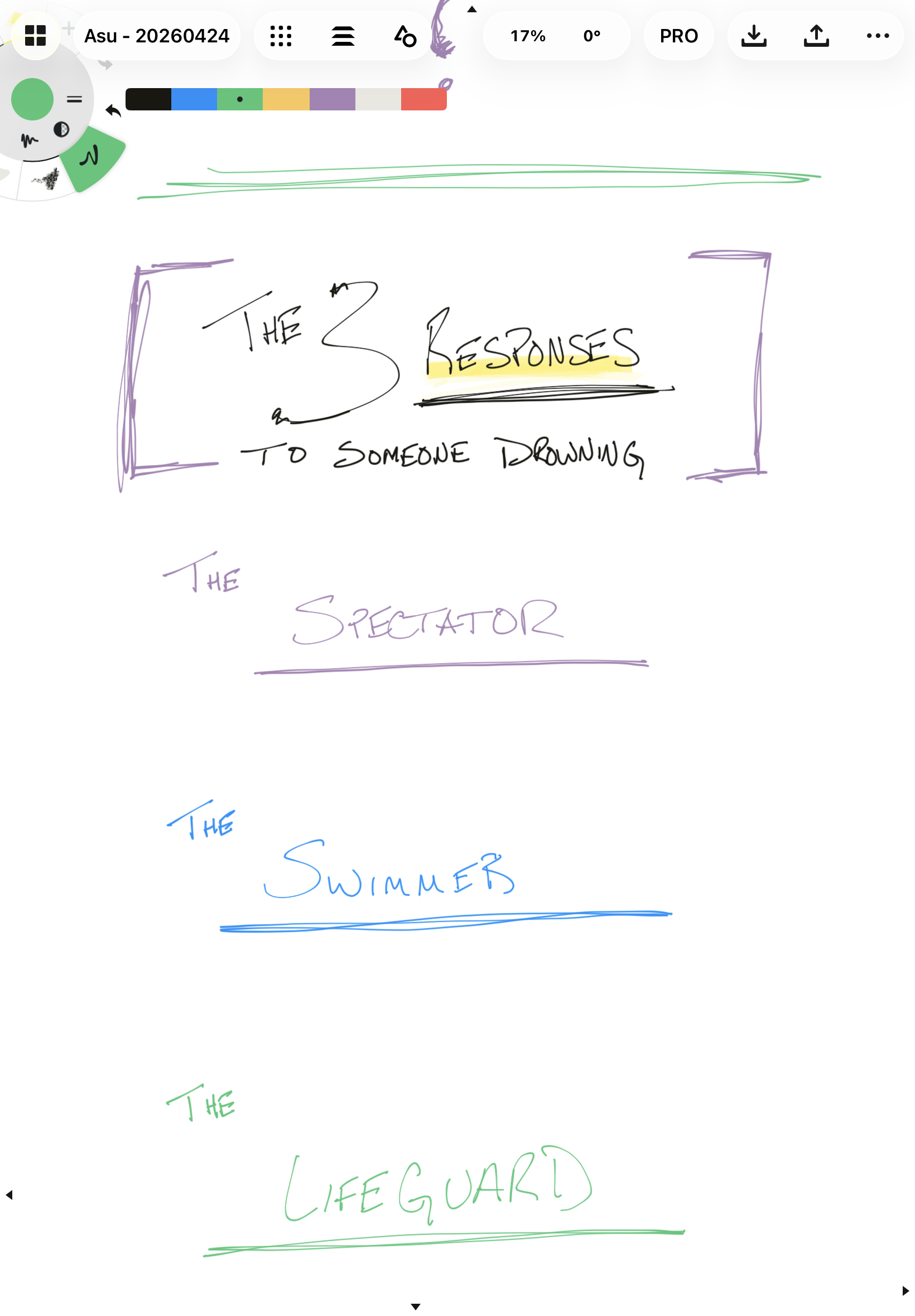
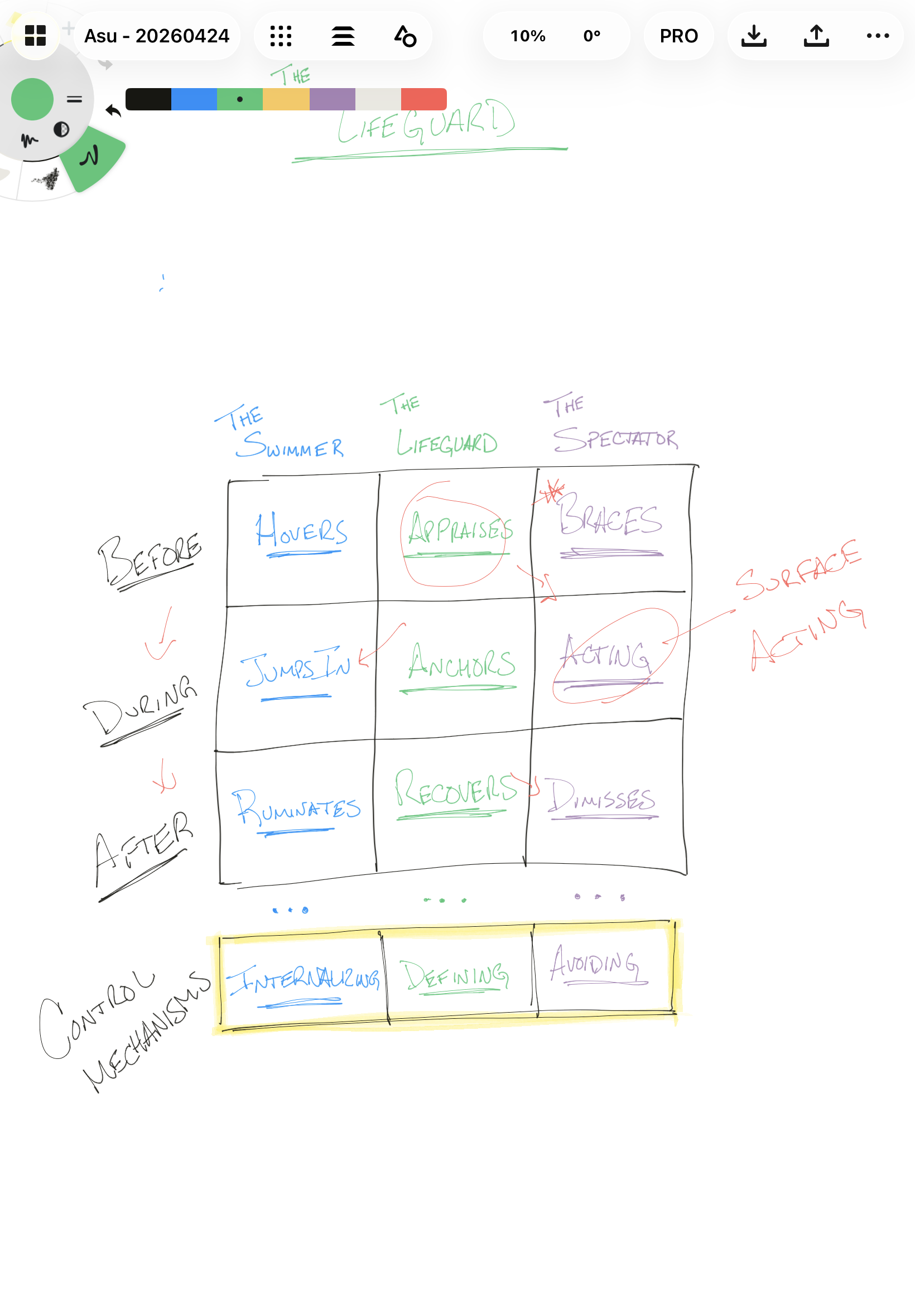
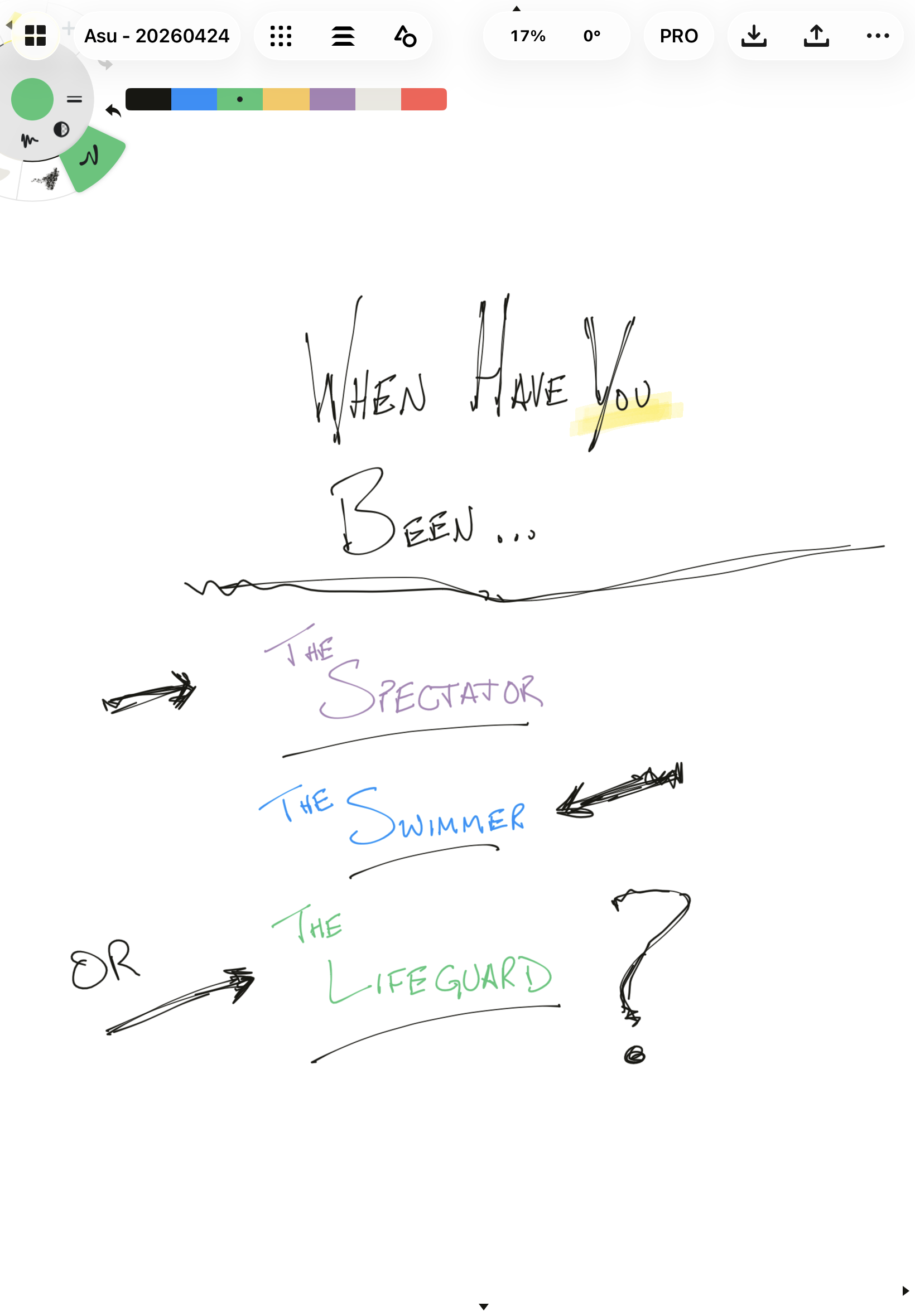
Three ways people try to control their emotional exposure to caregiving: Spectator, Swimmer, Lifeguard.
Crossed with three phases of an interaction: Before, During, After. That’s the 3x3 Grid we used to diagnose where each of us drifts under pressure.
Only one of the three is sustainable.
⚓ Three anchors that held the room
- Empathy is not Compassion. Empathy shares the pain network in your brain. Compassion runs on a different circuit — warmth and care from your own footing. Only one of them fatigues.
- You’re not the main character. You’re an important character in their story. Lifeguards stay on the deck because they care, not in spite of it.
- Care without carrying. Compassionate detachment is the sustained skill — engaged, from outside the problem.
The full breakdown — Spectator/Swimmer/Lifeguard cell-by-cell, plus the Lifeguard Playbook from Alicia Grandey’s research — lives on the deep resource page below.
-
🌊 Swimming Out — Personal Inventory
Cam off, three minutes alone: When have you been the Swimmer? Where do you find yourself swimming out? Be specific. Name names.
Then breakouts on two questions:
- What’s your biggest pattern?
- What helps you be the Lifeguard?
Chat blast to close the segment: one thing you’re learning about yourself right now.
-
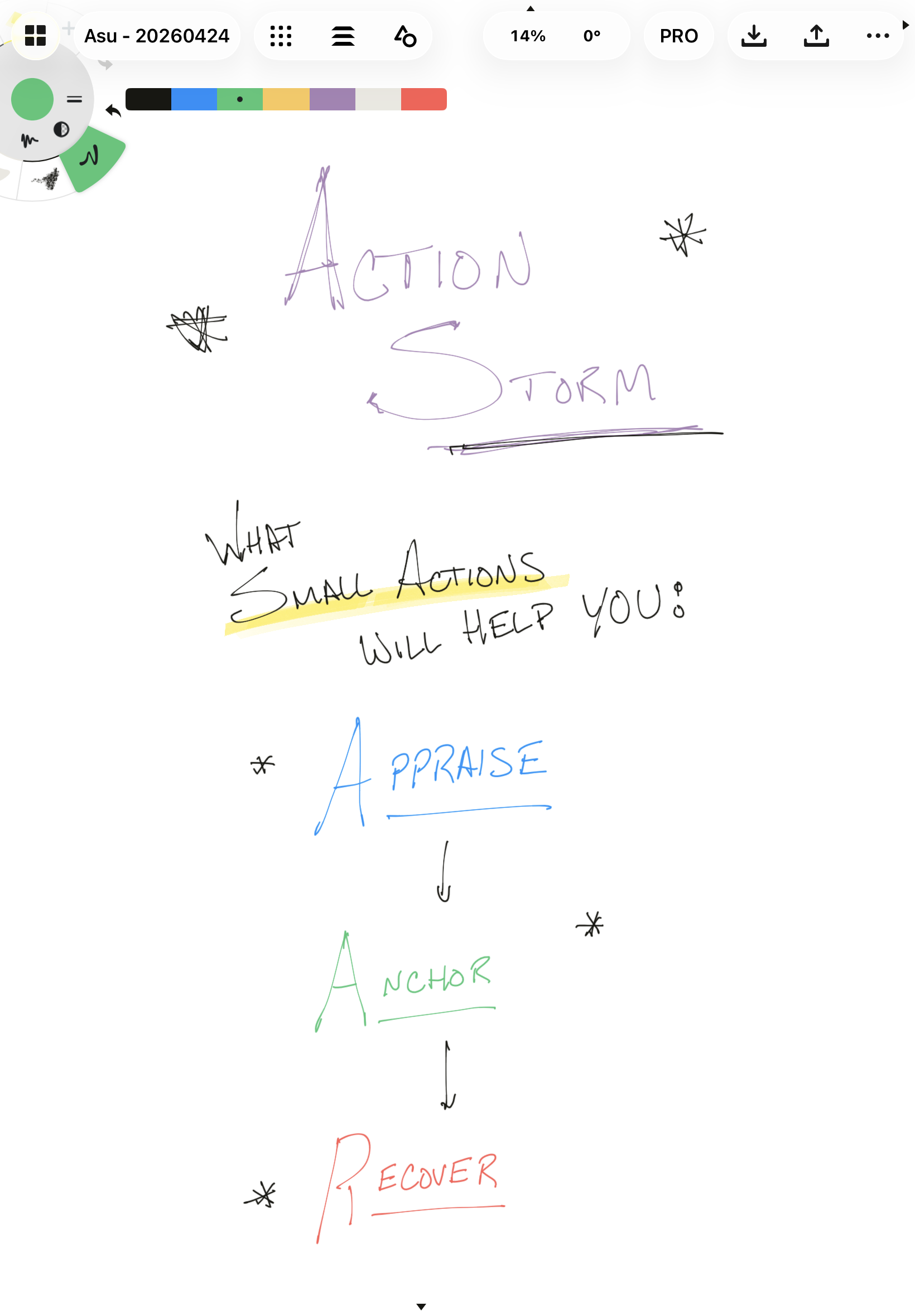
🎯 Action Storm + Accountabilibuddies
Three minutes alone: What small actions will help you Appraise, Anchor, and Recover?
Then in pairs, finish these two sentences out loud:
“When I leave I will ___. You can help me by ___.”
Pro TipThe 3-month phone reminder
Set a recurring reminder on your phone every three months: “Are you being the Swimmer or the Lifeguard?” Future you will thank present you.
-
✨ Closing
On your way out, finish one of these in the chat:
- “I am ___”
- “I believe ___”
- “I will ___”
Behind the curtain When we name it, it’s more likely we’ll do it or believe it.
Go deeper 📚 The full version of what we worked through
Compassionate Detachment — Deep Resources
The cleaner version of what we worked through live, plus the disambiguation we didn’t get to — compassion fatigue, empathic distress, burnout, compassionate detachment. What each one means, and why the differences matter.
The 3x3 Grid — quick reference
The diagnostic from the session. Print it. Tape it inside a cabinet. Glance at it before the next hard conversation.
Other Free Resources
In-Person Session: Connected Teams
-
🃏 Unofficial Start
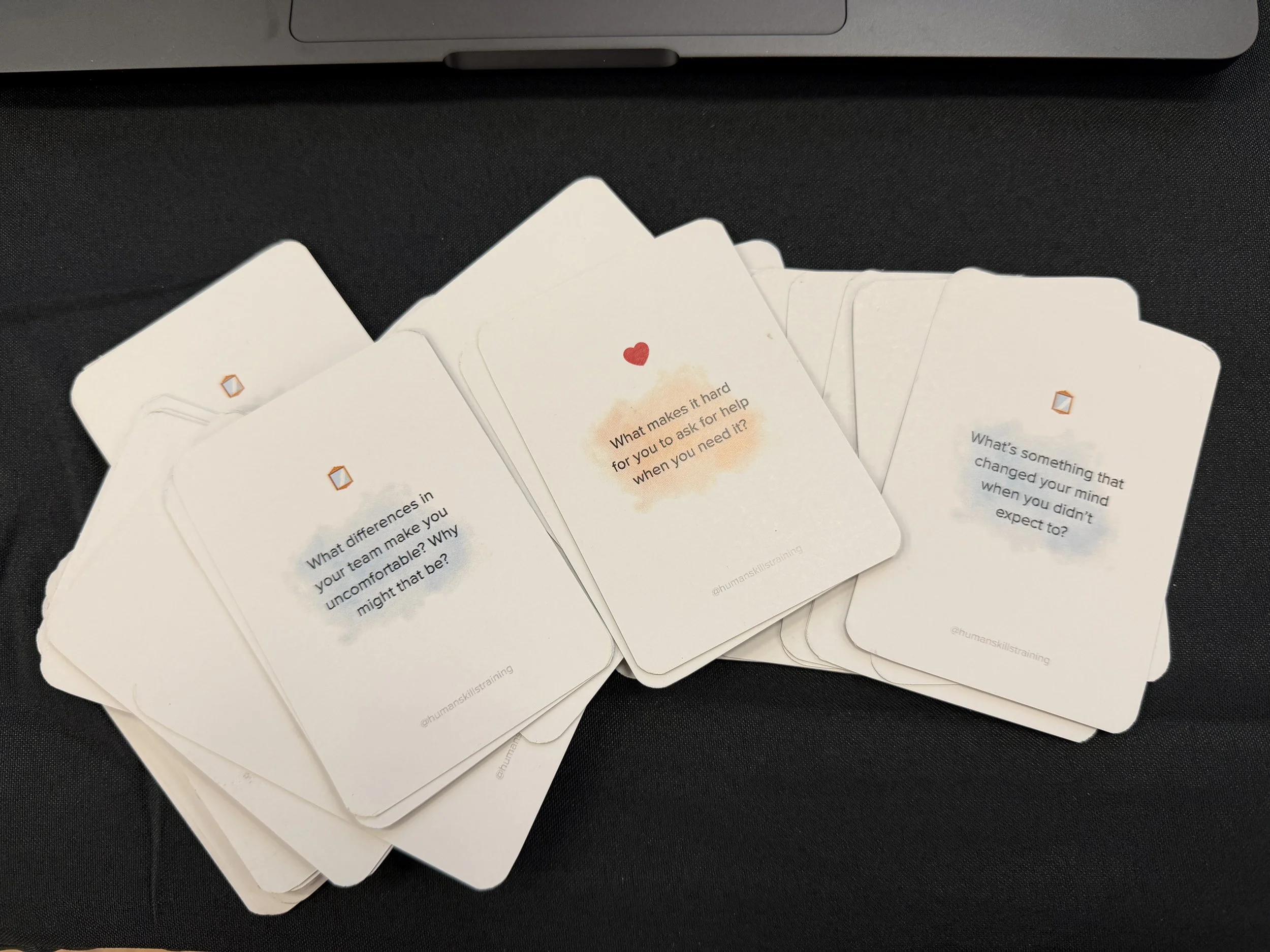
Take a card.
What story does this bring up about how you connect with your team at work?
Behind the curtain Time is the only resource we don’t get back. Most workshops waste the first ten minutes waiting for stragglers. The cards turn that waiting into the first piece of work we did together — a deliberate use of the time we had. -
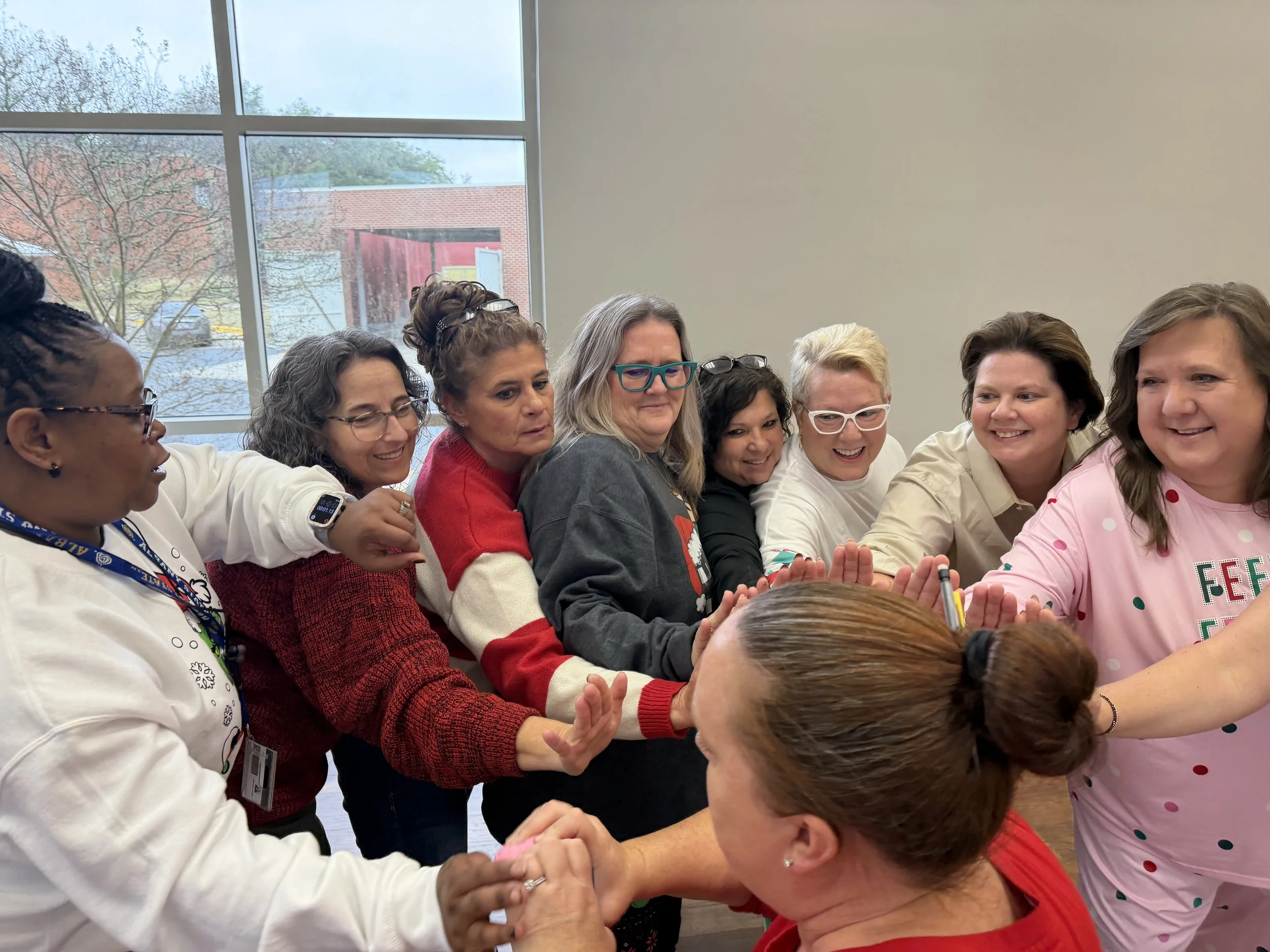
🤝 Connection Before Content
Card swap. Trade with someone in the room. Now you’re holding someone else’s story.
-
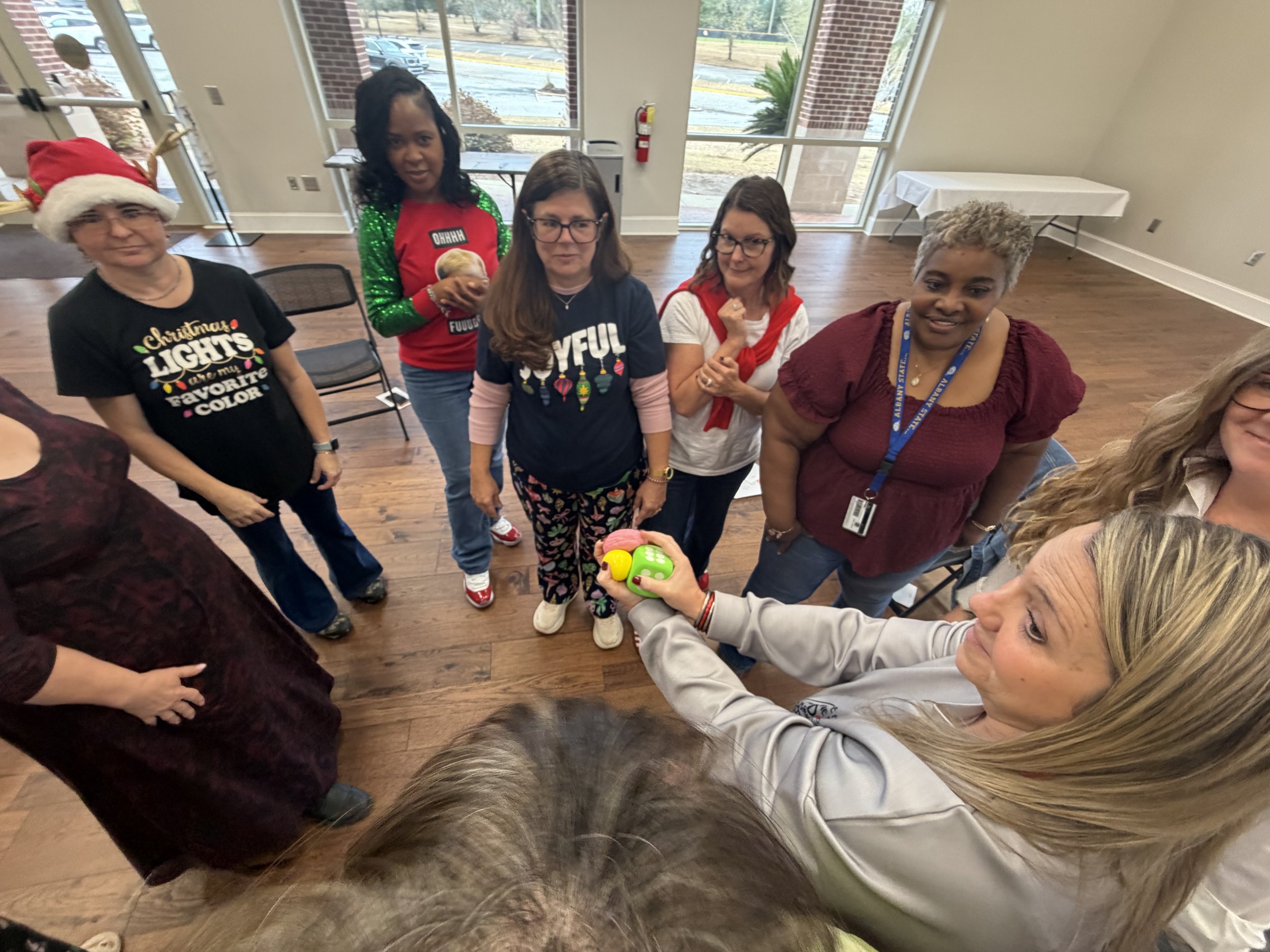
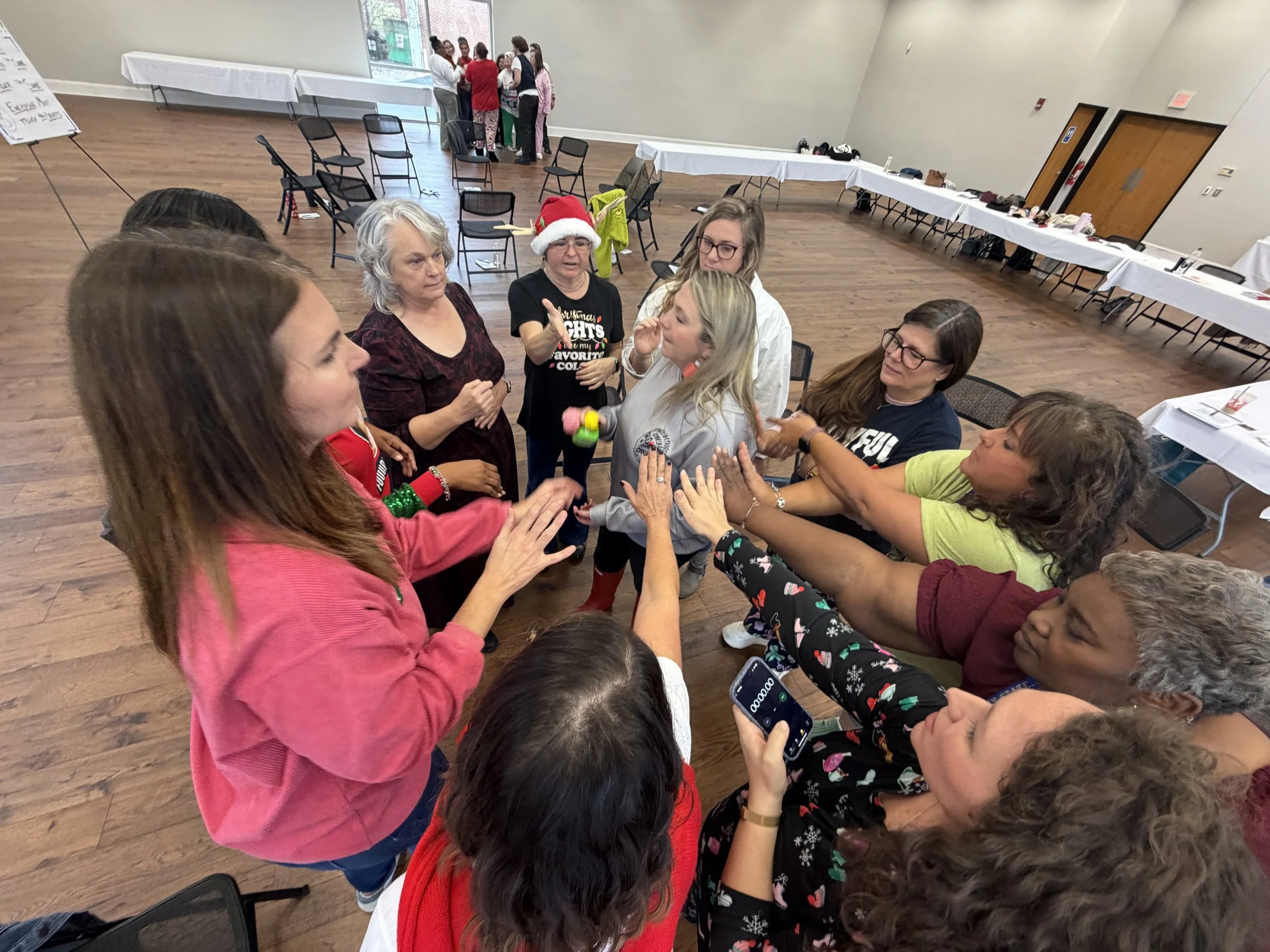
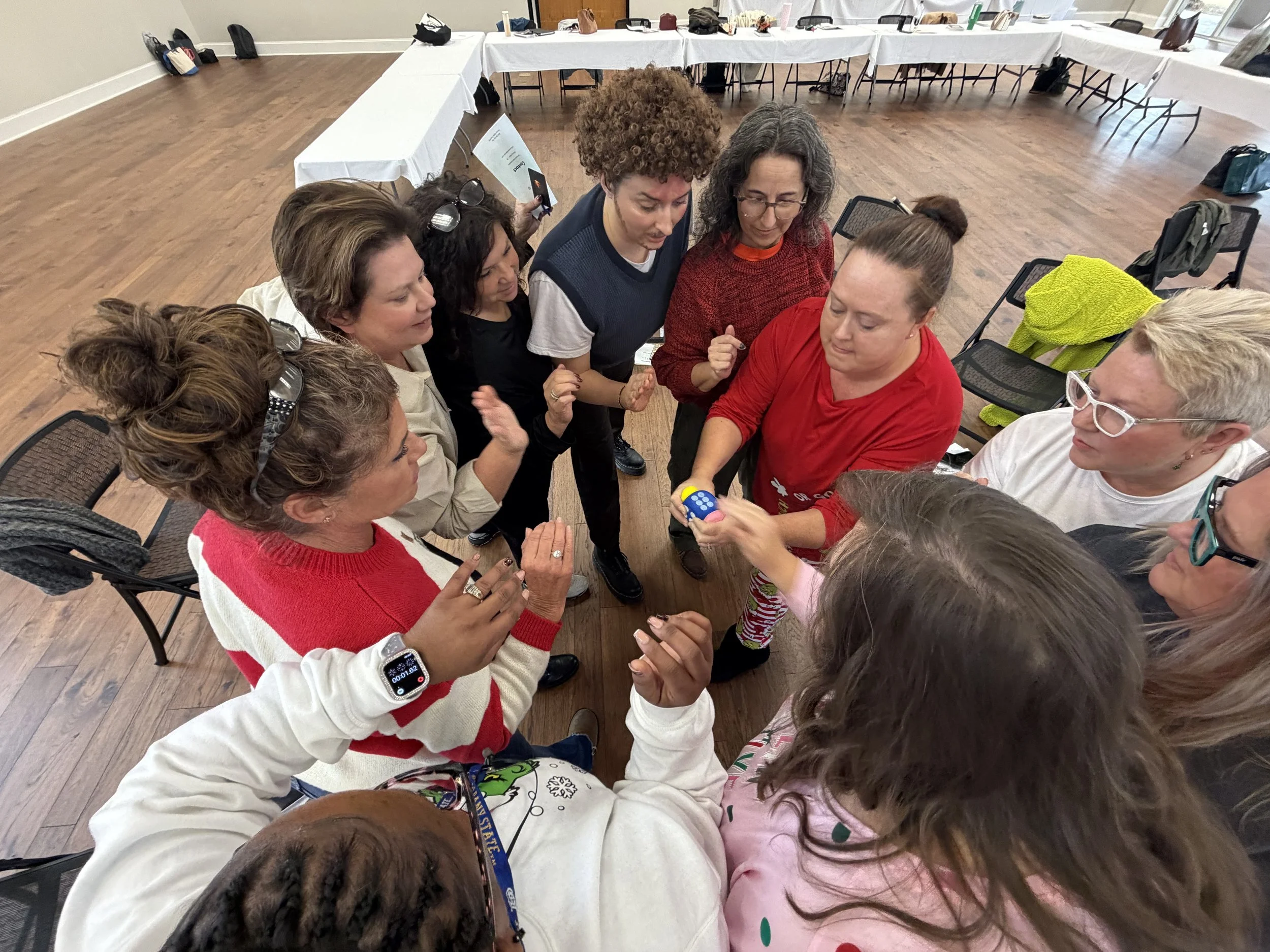
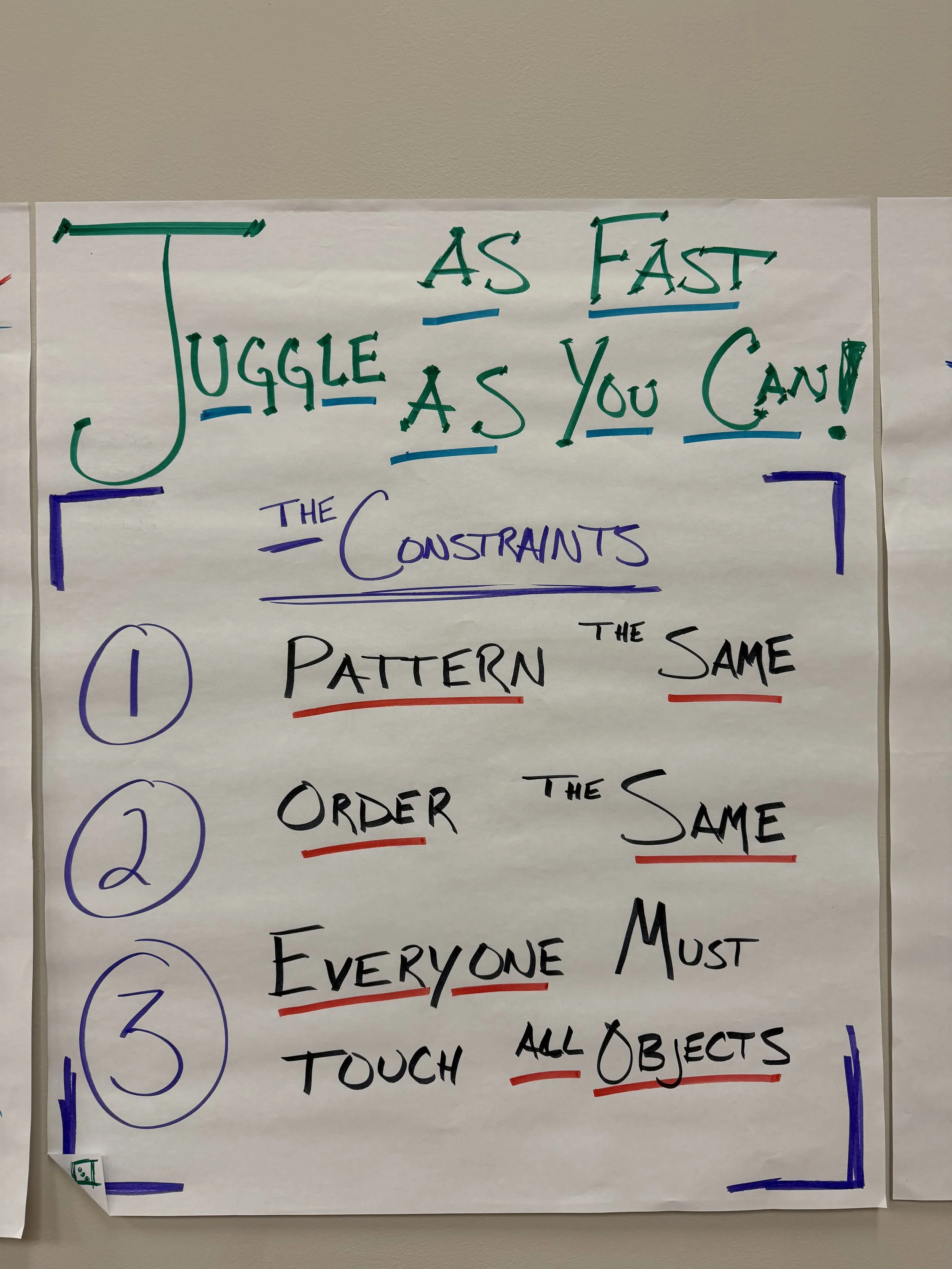
⚡ Juggle As Fast As You Can!
Our first team challenge. An hour of juggling, iterating, and trying again.
⚓ Three anchors we named afterward
- Psych Safety > Performance. The team that can say “I don’t know” out loud is the team that gets faster.
- Agreement / Alignment. Getting everyone to agree is nearly impossible. Aligning on a shared goal gives your team the buy-in to execute, test, and figure out what’s next together.
- Listen to Win. Not to wait for your turn. Not to fix. Listen so you can actually move with the people next to you.
-
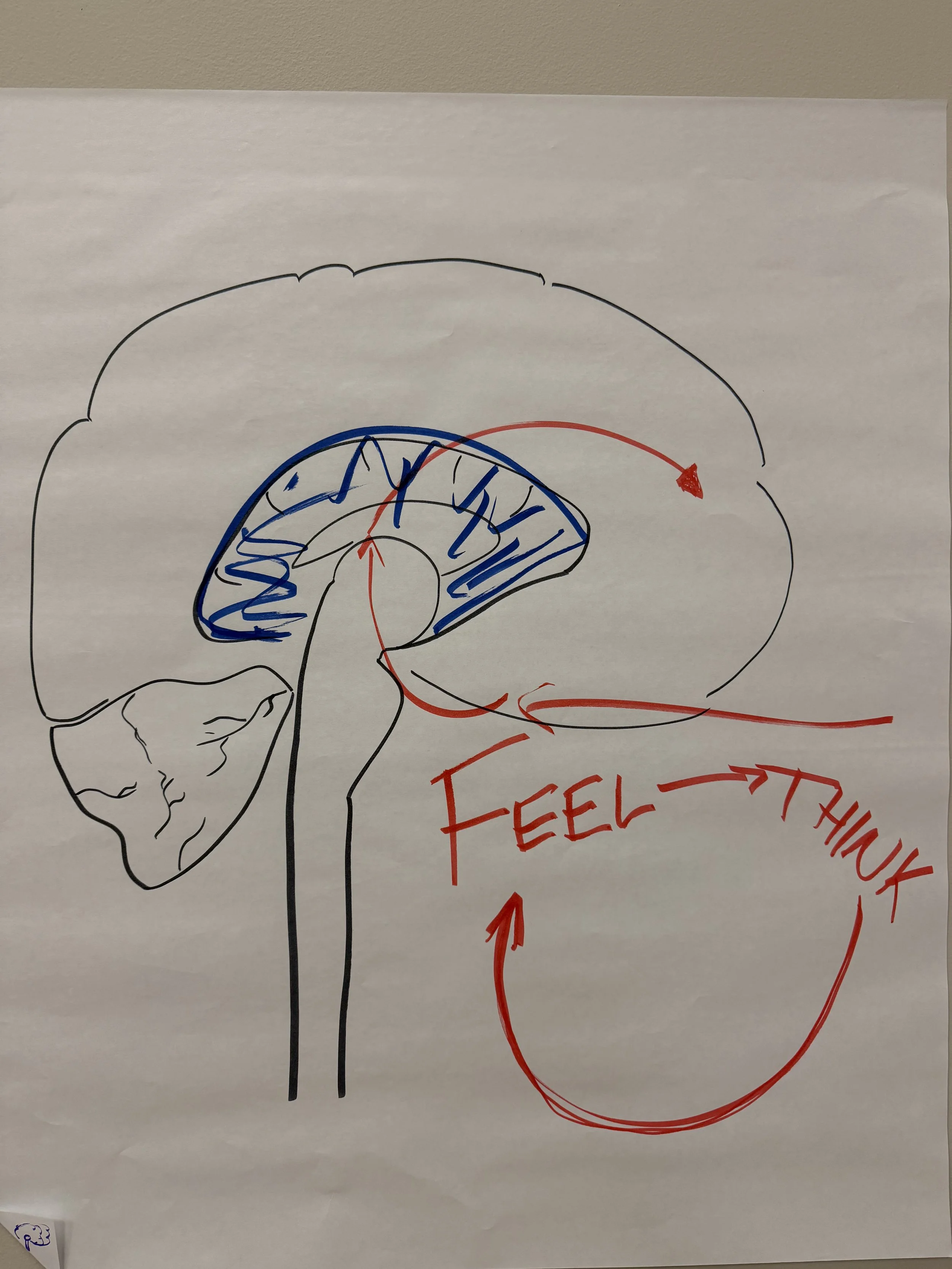
🧠 The Neuroscience Lab at Penn State
We feel, and then we think. Always in that order. The proof? Your biological response to a 🍋 lemon that wasn’t there.
-
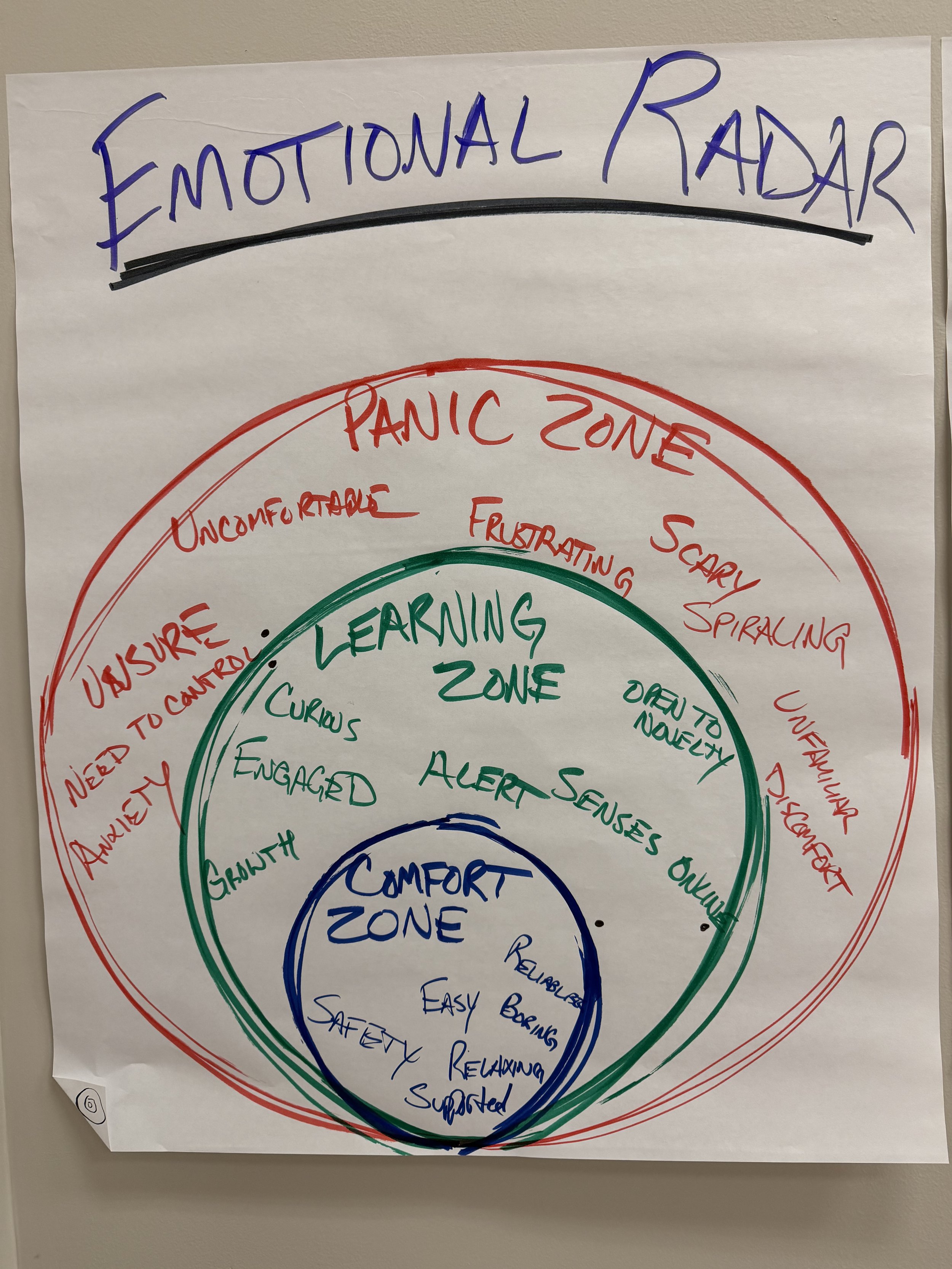
📡 Emotional Radar
Map your team across the empathic-distress ↔ compassion axis. Where are people sitting right now? Where do they drift under load?
-
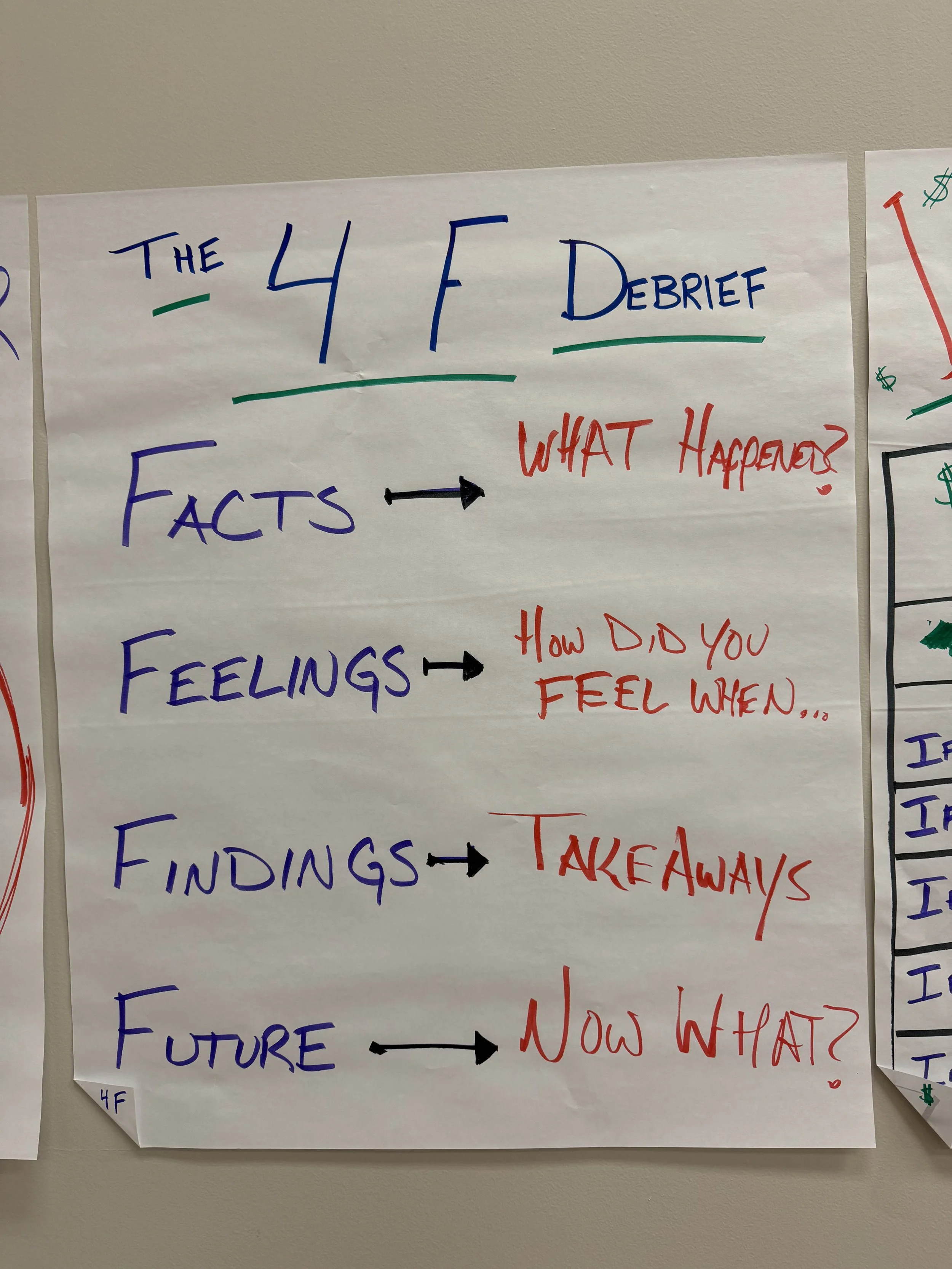
🔄 4F Debrief
Facts · Feelings · Findings · Future. Five minutes alone, then together — the room named what was actually happening across the morning’s work.
-
🍽️ Lunch
Pause. Reset. Eat together.
-
🤝 Connection Before More Content
Get in a trio. What’s one insight you’ve had so far? Share it.
-
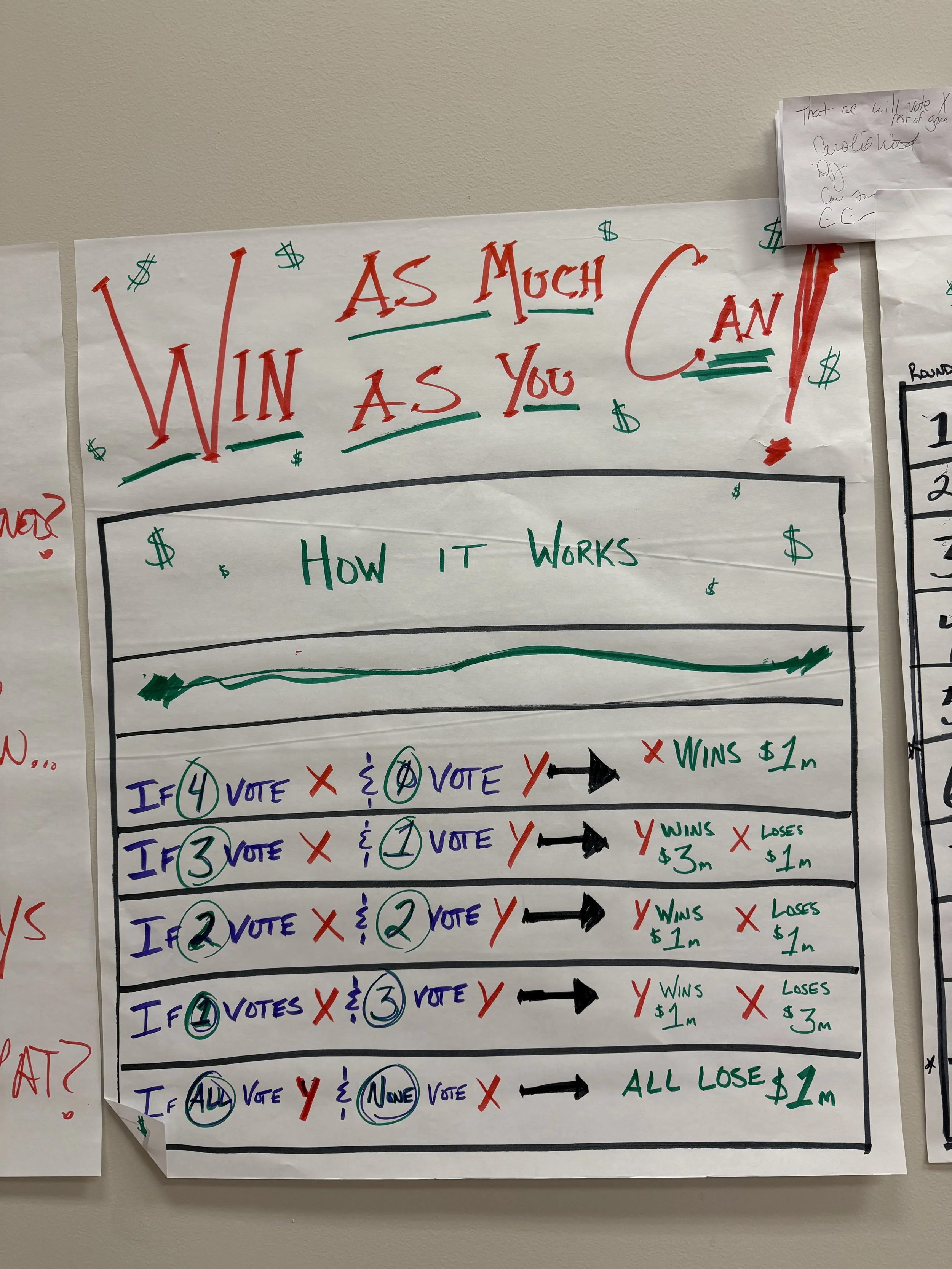
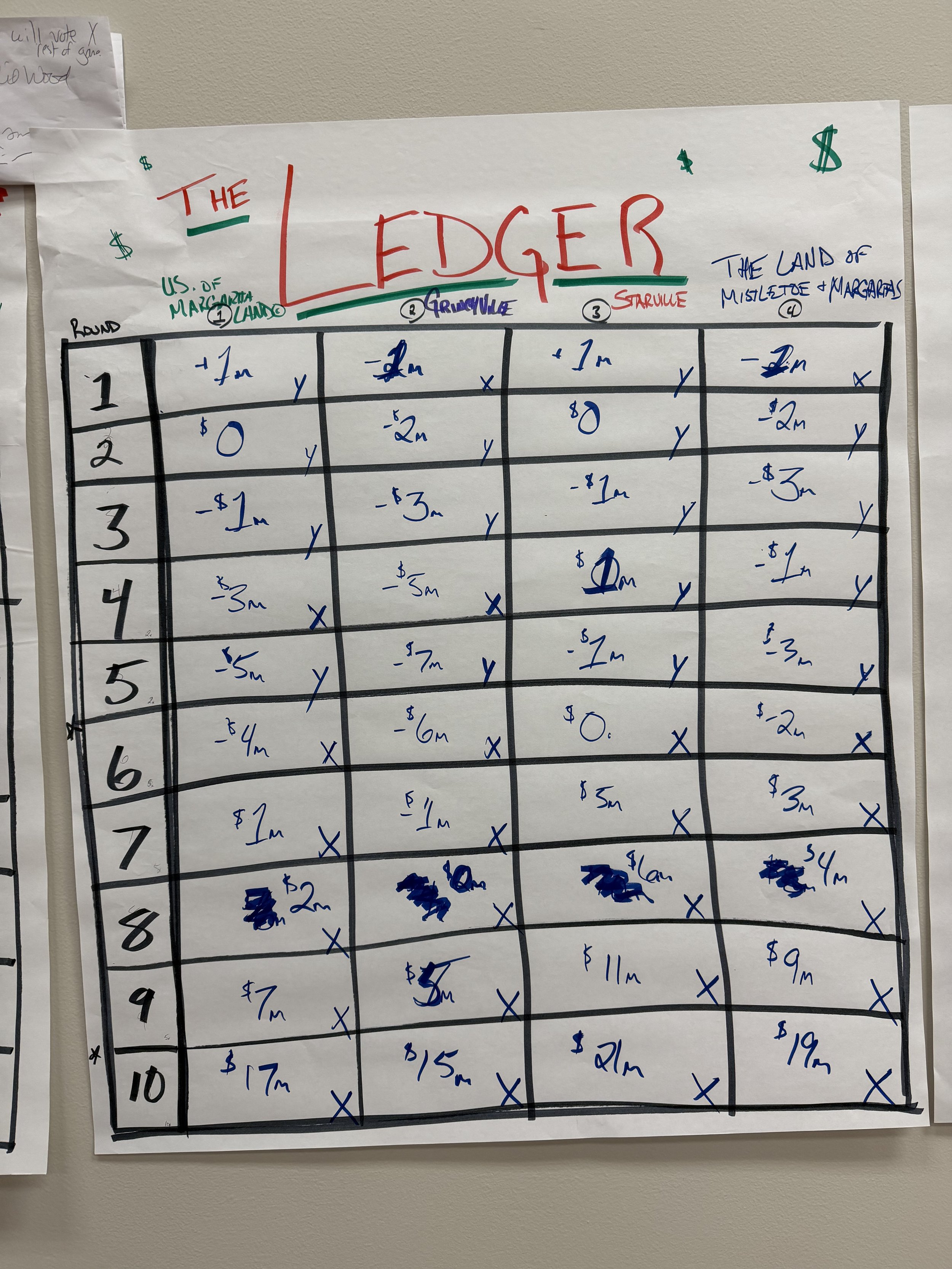
🏆 Win As Much As You Can!
A team-vs-team game where the only way to actually win is to stop playing against each other. Then the debrief.
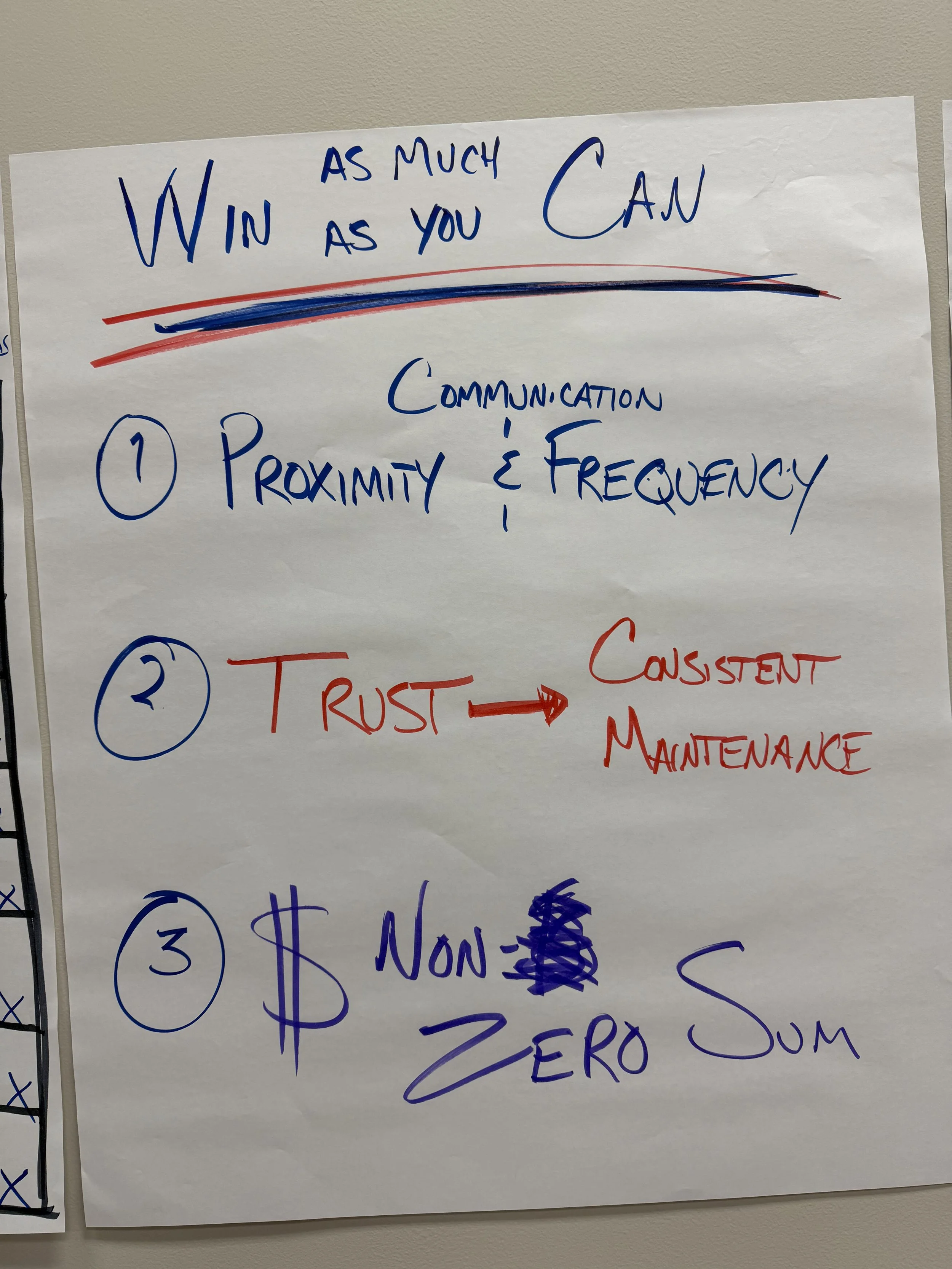
⚓ Three anchors we named afterward
- Proximity & Frequency. Trust is built by being close enough, often enough — not by big gestures spaced too far apart.
- Trust is consistent maintenance. Not a milestone you cross. A practice you keep up.
- Not Zero Sum. Most of the games we play at work aren’t actually zero-sum. We just inherited the rules.
-
💡 Sparking Connection
How to start a connection on purpose, not by accident. Two moves we walked through:
📖 Two moves that came up
MoveChange “Why” to “How”
“Why did you do that?” puts the other person on defense. “How did you end up there?” opens the same door without the door slamming back. Same curiosity, different room temperature.
Move🔍 Be the Detective, not the Judge
The Judge already decided the verdict and is looking for evidence. The Detective is looking for what’s actually true. Pick on purpose.
-
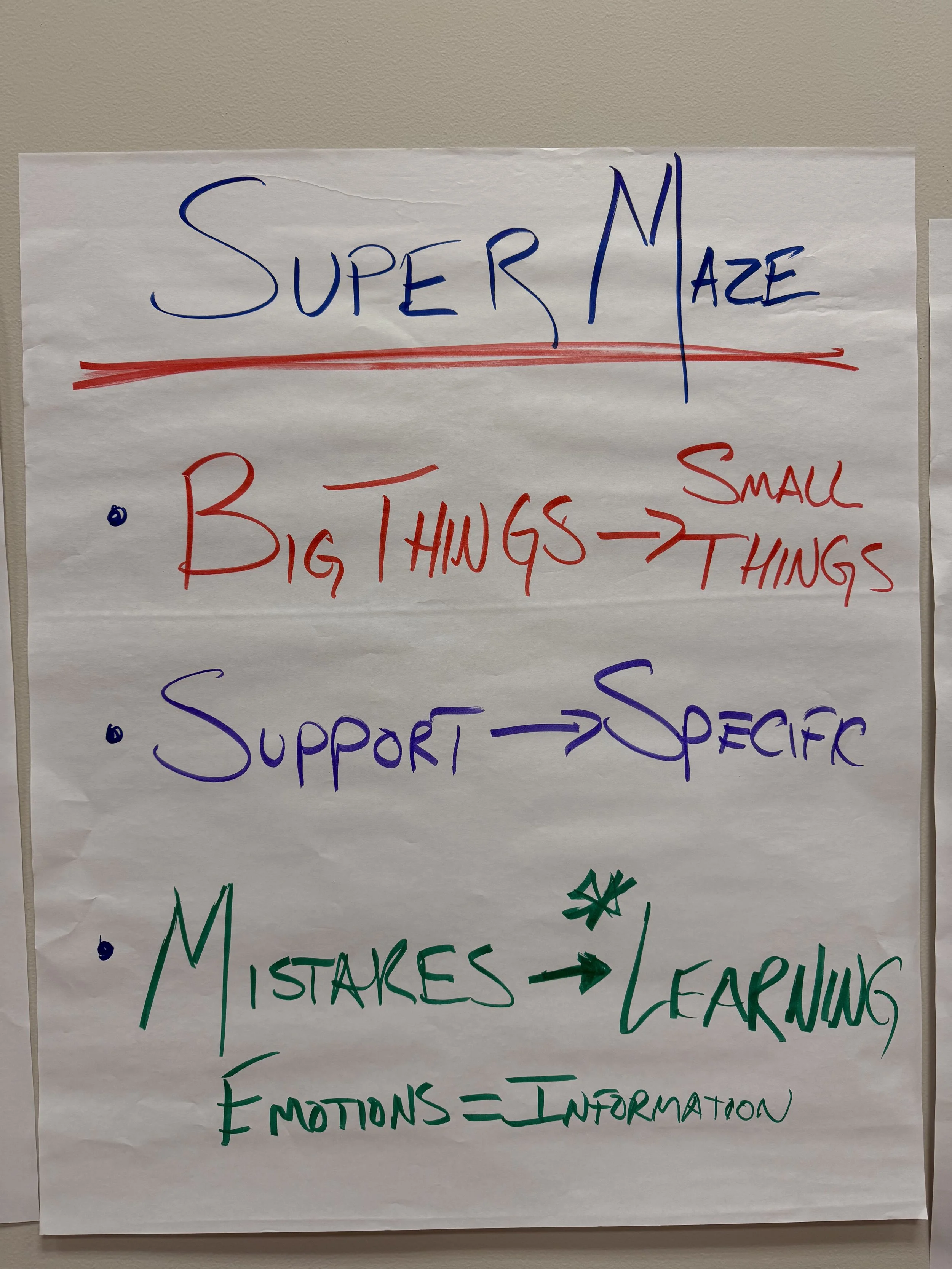
🧩 The Maze
The afternoon’s team challenge. An hour navigating a path you can’t see, with help from people who can.
⚓ Three anchors we named afterward
- Small things. The micro-moves — a nod, a single word of direction, a pause — are what actually moved the team forward.
- Specific Support. “You’re doing great” is noise. “Step left, six inches” is help. Specific beats general every time.
- Mistakes → Learning. The fastest teams weren’t the ones that didn’t miss. They were the ones that turned a miss into a correction in the next move.
-
🎯 Action Storm
Five minutes in a trio: What’s one takeaway and how will you apply it? Cross-pollinate.
Then five minutes alone, getting specific:
- What will you do?
- How will you know it’s working?
-
✨ Closing
“You were spectacular today because ___.”
That’s the exit mechanic. Instead of clapping, find someone you hadn’t talked to yet and finish the sentence.
Behind the curtain Applause points the attention back at the front of the room. This sends you out specific, named, and seen by someone else — which is where the focus belongs at the end of a day like this.
What you took home 🎒 The Human Skills Cards and Workbook
🃏 The Human Skills Cards
One question per card. Built to start the kind of conversation that doesn’t happen by accident. Use it at work, at the dinner table, anywhere small talk is doing the work that real questions should.
📓 The Human Skills Workbook
Frameworks, anchors, and the prompts from each segment, all in one place. Built to be marked up, not preserved.
Other Free Resources
🎧 That playlist tho . . .
How Can I Help You?
Budgets are changing.
In-person PD days are rare.
Here are other ways I may be able to support your team:
Custom Connection Card Decks for coaching and training
Virtual PD for Emotional Intelligence, Facilitation Skills, Difficult Conversations, How to use AI
Train The Trainer for training design, PD design, or DIY challenges
Culture As A Service: A comprehensive culture evaluation and maintenance for your entire team
How To Properly Wield A Butter Knife